




By Prof. (Dr.) Rangamini Werawatta
For centuries, educational theorists and philosophers have argued a fundamental premise: if an individual possesses mathematical logic and mastery over a single language, they hold the key to learning virtually any discipline on Earth. Today, this principle manifests as prompt engineering, where language becomes the ultimate interface to command modern intelligence. Language is not merely a tool for daily social exchange; it is the fundamental medium through which knowledge is stored, retrieved, and weaponized.
Throughout human history, mastery of language has meant mastery over power.
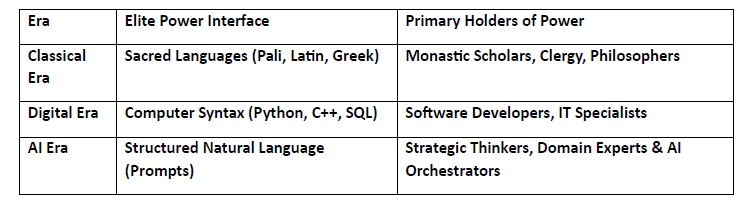
In classical antiquity, authority was directly bound to elite linguistic keys. In Theravada Buddhist scholarship, for example, prominent scholars command immense authority not simply through general piety, but through their deep mastery of Pali. Though Pali is an ancient liturgical language, it houses the Tipitaka—the foundational texts of Buddhist philosophy. Knowing Pali grants direct access to primary sources, allowing scholars to interpret, critique, and lead. The language itself became the exclusive key to the vault of knowledge.
The Macro-Evolution of Human Progress
To understand how we arrived at the current technological inflection point, we must look at the broad trajectory of human development across four distinct historical epochs:
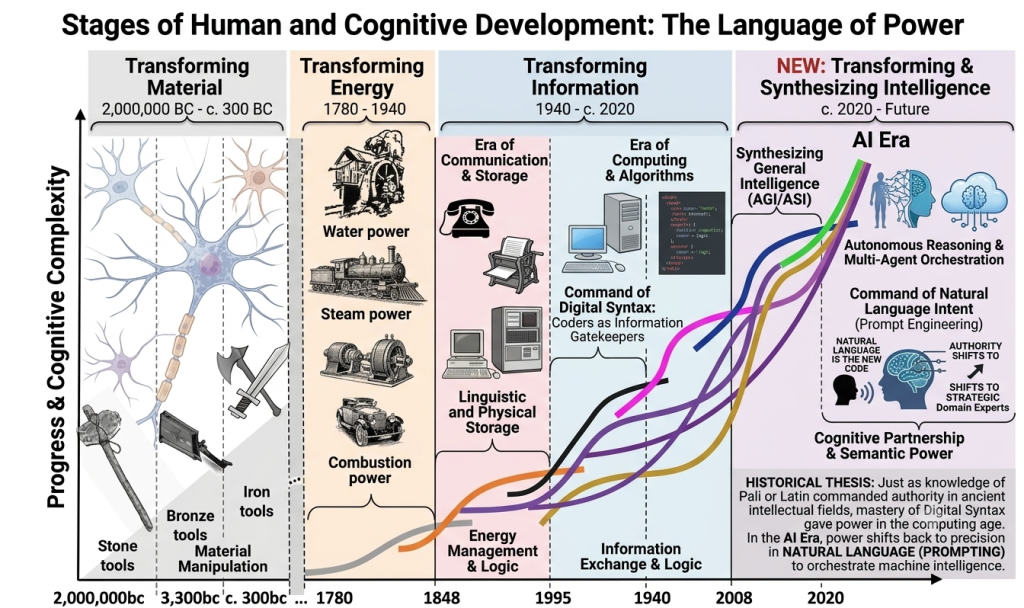
Illustration developed by Author.
1.Transforming Material (2,000,000 BC – c. 300 BC): Early humans asserted dominance by manipulating physical matter—from stone axes to bronze and iron tools.
2.Transforming Energy (1780 – 1940): The Industrial Revolution shifted human leverage to harnessing thermodynamic and electrical power—steam, combustion, and water power.
3.Transforming Information (1940 – c. 2020): The digital era introduced electronic computing. Power shifted to those who controlled information storage, algorithms, and digital syntax (programming languages like C++, Java, and Python). Software engineers became the elite gatekeepers of the machine world.
4.Transforming & Synthesizing Intelligence (c. 2020 – Present): We have entered the AI Era. The fundamental curve of progress is no longer limited by how fast humans can write code or store data. Progress is driven by our ability to synthesize intelligence in real time using Natural Language. Prompt engineering has emerged as the defining technical skill of the generative AI era.
Real-World Enterprise Adoption: Prompting as an Industry Power Skill
Across global industries, Prompt Engineering has rapidly transformed from an experimental curiosity into a high-value core competency.
• Law & Legal Governance: Law firms use structured prompt frameworks to parse thousands of complex regulatory documents in seconds. Paralegals who master semantic prompting can audit enterprise contracts faster than entire legacy legal teams.
•Healthcare & Medical Research: Medical researchers employ natural language directives to query vast genomic databases, model drug interactions, and summarize clinical trials, accelerating diagnostic pipelines.
• Software & Enterprise Architecture: Senior system architects use natural language prompts to generate entire microservice boilerplates, run automated security audits, and orchestrate multi-agent workflows without writing line-by-line code.
In modern enterprise setups, prompt engineering is recognized as advanced semantic logic and context design: setting operational boundaries, defining persona constraints, structuring output formats, and managing iterative reasoning chains. By mastering prompt engineering, non-technical individuals can bypass traditional execution bottlenecks.
The “Amateur Advantage”: Collapsing the Knowledge Barrier
Historically, entering a complex domain—be it data science, financial engineering, or intellectual property law—required years of specialized academic gatekeeping. You had to spend years learning the “jargon” and mechanics before achieving functional competence.
Natural language interfaces completely dismantle this barrier. Today, an ambitious amateur equipped with strong domain curiosity and structured prompting skills can achieve unprecedented leverage:
[Legacy Path] Zero Knowledge —> Years of Technical/Syntax Training —> Applied Expertise
[AI Era Path] Zero Knowledge —> Structured Natural Language Prompts —> Instant Execution & Intelligence
• On-Demand Mentorship: An amateur can prompt an LLM to explain high-level quantum mechanics, econometric modeling, or cloud architecture using tailored analogies, instantly bridging their knowledge gap.
• Instant Translation of Intent to Execution: An individual with zero background in Python can describe a business problem in plain English, and an AI agent will generate the data analysis pipeline, execute the code, and visualize the findings.
• Levelling the Playing Field: The bottleneck is no longer how to execute a technical task; it is knowing what strategic questions to ask.
The New Competency Hierarchy
Conclusion: Reclaiming the Power of the Spoken Word
Human language began as a tool for oral communication, evolved into written scripts that preserved institutional power, transformed into synthetic syntax to control microprocessors, and has now returned as the primary interface for commanding artificial intelligence.
For professionals, students, and leaders, the takeaway is clear: technology mastery in the post-AI world is no longer about memorizing technical syntax. It is about cultivating clarity of thought, deep domain understanding, and the linguistic mastery to command intelligence.
Just as ancient scholars held authority through their command of Pali, those who master the art of natural language prompting will hold the keys to power in the age of intelligence.