




By Prof. Dr. Rangamini Werawatta
For nearly three decades, the path into a lucrative tech career was remarkably straightforward: learn a popular programming language, master a web framework, practice algorithmic drills, and secure an entry-level software engineering role. Writing clean syntax and implementing repetitive logic was the gold standard of technical capability.
That model is now dead.
With the rapid maturation of generative AI, large language models, and autonomous coding agents, the foundational unit of the software industry—writing pure code—is being commoditized in real time. What used to take a team of three junior developers a full sprint to build, test, and refactor can now be generated by an AI coding assistant in minutes.
This shift is not a distant prediction; it is an active market correction. From Silicon Valley tech giants executing massive AI-driven restructurings to local IT export firms quietly adjusting headcount, Sri Lanka has officially joined the global wave of AI-induced recalibration.
However, this is not the end of software engineering as a discipline—it is the death of the traditional execution model. To survive, the tech ecosystem must confront a widening talent gap, an internship crisis, and a fundamental breakdown in how we evaluate and prepare modern tech talent.
The Internship Bottleneck and the “Junior Paradox”
The most immediate casualty of this transformation is the entry-level job market. Globally and locally, students are finding it exceptionally difficult to land traditional software engineering internships.
Historically, companies hired interns and junior developers to handle “grunt work”—writing boilerplate code, updating documentation, running manual unit tests, and fixing low-priority bugs. Today, AI handles those exact tasks with near-zero latency. As a result, tech firms are drastically shrinking their intake of interns and entry-level staff.
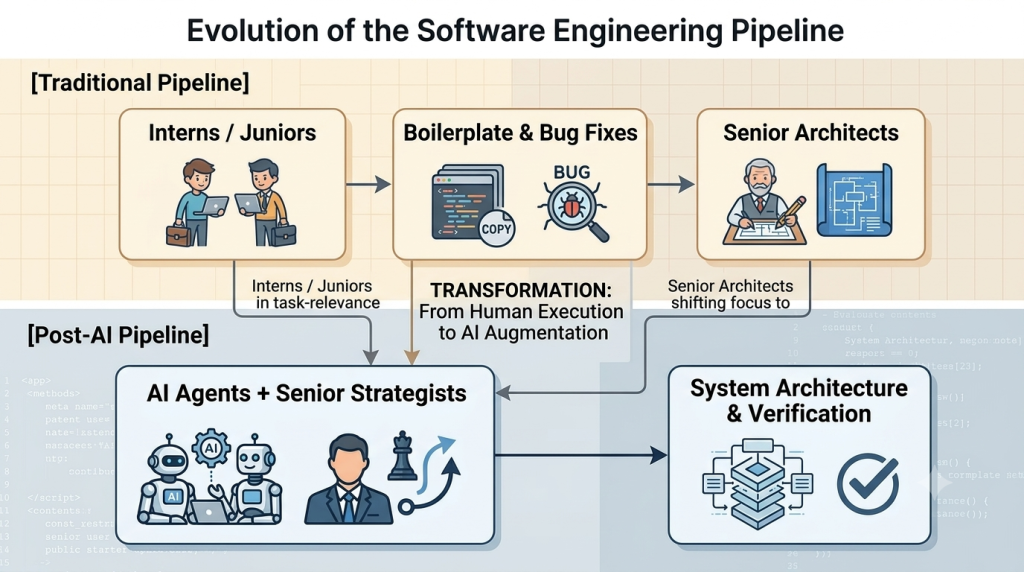
This creates a dangerous industry paradox: If companies stop hiring and training junior developers, where will tomorrow’s senior system architects come from?
By relying strictly on senior talent augmented by AI, firms are solving short-term productivity goals while systematically destroying the talent pipeline that sustains the industry.
The K-SAM Breakdown: Knowledge and Skills vs. Attitude and Mindset
To understand why Gen Z graduates are struggling within modern corporate setups, we must look at the K-SAM model (Knowledge, Skills, Attitudes, Mindset/Paradigm). Grounded in Outcome-Based Education and embedded within the Sri Lanka Qualifications Framework (SLQF), K-SAM defines the complete competency profile required of a modern graduate.
The reality facing hiring managers across Sri Lanka’s tech sector is stark: Gen Z entrants possess Knowledge and Skills to a reasonable extent, but their Attitude and Mindset Paradigm are lacking big time.
1. Knowledge (K): High access to information, AI assistants, and documentation means today’s graduates can absorb technical theories faster than any previous generation.
2. Skills (S): They are inherently digitally fluent. They can write prompts, utilize dev tools, and assemble prototypes rapidly.
3. Attitudes & Values (A): Here lies the collision point. Many entrants exhibit a low tolerance for institutional process, struggle with corporate hierarchy, and display fragility when facing rigorous code audits or critical feedback. What seniors view as “necessary enterprise governance,” Gen Z frequently dismisses as “useless corporate overhead.”
4. Mindset & Paradigm (M): The SLQF defines Mindset and Paradigm as having a broader “Vision for Life” and understanding how individual output impacts institutional goals. Many new hires enter with a gig-economy mindset: “I complete ticket #102, you pay me.”
They lack organizational ownership, long-term strategic alignment, and the systems-thinking required to build resilient enterprises.
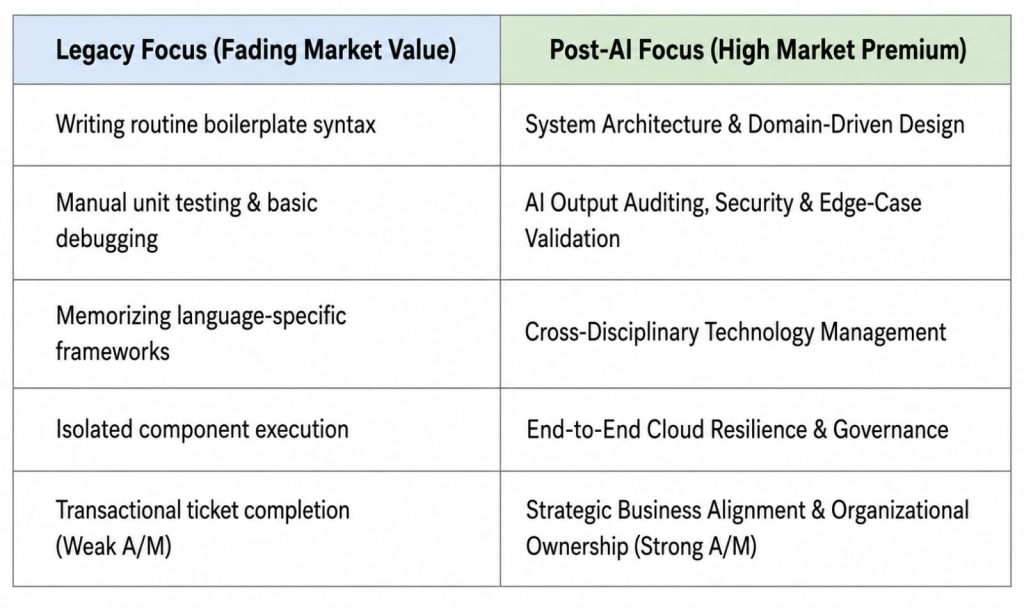
The New Competency Matrix: What Modern Tech Leaders Demand
To remain viable in an AI-dominated market, software professionals must transition from being code writers to technology strategists and AI orchestrators.
Re-Engineering Higher Education and Corporate Governance
Sri Lanka cannot afford to let its IT export sector—one of the country’s vital economic drivers—stagnate through obsolete training models. Overcoming this disruption requires an immediate, coordinated overhaul between universities and private sector leadership:
- Incorporate K-SAM Holistically in Tertiary Education: Higher education institutions must stop grading students purely on whether their code compiles (Knowledge & Skills). Curricula must assess peer review etiquette, conflict resolution, security governance, and business alignment presentations (Attitudes & Mindset).
- Redefine the “Internship”: Companies must abandon using interns for routine coding. Internships should be restructured as Architectural Apprenticeships, where students shadow senior engineers to learn how to guide AI models, audit system outputs, and navigate complex business requirements.
- Modernize Corporate Onboarding: Corporate leaders cannot simply demand Gen Z conform to 1990s workplace norms. Management must framework around impact and strategic autonomy rather than desk hours. When Gen Z understands why a protocol exists, their attitude shifts from resistance to optimization.
Conclusion
Artificial Intelligence will not replace software engineers. However, software engineers who leverage AI, system architecture, and strategic technology management will inevitably replace those who rely solely on writing code.
By addressing the entry-level hiring bottleneck, reforming tertiary education to focus heavily on the Attitude and Mindset Paradigm, and aligning Gen Z’s potential with modern enterprise workflows, Sri Lanka can elevate its tech workforce from low-tier execution units to high-value global technology leaders.