



By Kawditha Nirmal for Techie.Lk
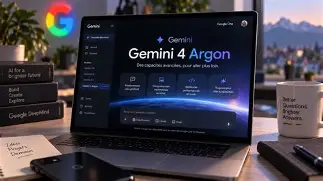
Google has introduced a new addition to its Gemini AI family called Gemini 4 Argon, designed to support a range of tasks, including software engineering, knowledge work, and cybersecurity. Google says the model places particular emphasis on cybersecurity, with capabilities aimed at identifying and addressing software vulnerabilities.
Google says Gemini 4 Argon is not yet available to the general public. Instead, access is being offered to trusted cyber defenders, selected governments, Google Cloud customers, and cybersecurity partners through Google’s Fairwind Programme.
Identifying and Fixing Software Vulnerabilities
One of the main claims about Gemini 4 Argon is its ability to identify, validate, and patch critical security vulnerabilities in software, which Google says it can do autonomously.
Rather than focusing solely on code generation, the model is designed to assist with complex cybersecurity tasks that can require significant time and technical expertise. These capabilities could help security teams investigate potential weaknesses, assess their impact, and develop appropriate fixes more efficiently.
Google developed the model with an emphasis on defensive cybersecurity, supporting efforts to strengthen software security and reduce the risks associated with vulnerabilities. Google also says it red-teamed the model for cyber and CBRN misuse, and that it resists indirect prompt injection well enough to lead the Gray Swan benchmark.
Enhanced Capabilities for Coding and Software Engineering
Beyond cybersecurity, Gemini 4 Argon is also described by Google as offering improvements in coding and software engineering.
Google says its own engineers are already using the model for everyday engineering tasks, including debugging and migrating large codebases, such as moving C and C++ code to Rust.
Another reported capability is its ability to maintain reasoning across long and complex workflows. Google says the model can produce up to 1 million output tokens, up from 64,000 in earlier Gemini models. This could make it useful for projects that involve multiple interconnected steps, extensive codebases, and demanding technical requirements.
If these capabilities perform as described in practical settings, they could help developers reduce repetitive work and improve their productivity when working on large software projects.
Analysing Images, Charts, and Videos
Gemini 4 Argon is also reported to support the analysis of visual information, extending its capabilities beyond text and code.
Google says the model can interpret charts and other forms of visual data, as well as analyse information contained in long videos. On LVBench, a long-video-understanding test, Google reports a score of 91.7%. Such capabilities could be useful in research, technical analysis, and workflows that require information to be extracted from multiple types of media.
Combining visual understanding with coding and reasoning capabilities could make the model useful for a broader range of professional tasks.
Competition Among Leading AI Models
Competition among major AI companies continues to intensify as organisations develop increasingly capable models for programming, reasoning, research, and specialised applications.
Google’s launch chart shows Gemini 4 Argon ahead of OpenAI’s GPT-6 Astra and Anthropic’s Claude Opus 5.5 and Claude Fable 5.1 on many benchmarks. It also reports 77.9% on DeepSWE v1.1, which it describes as state of the art.
Separately, the AI benchmarking platform Vals ranks Gemini 4 Argon first of 41 models on its Vals Index, with a score of 68.90%. Vals also found that it does not lead on every individual test. Claude Sonnet 5.5 scored 67.04%, Claude Opus 5.5 scored 66.97%, and GPT-6 Astra scored 63.13%. However, benchmark results should be interpreted carefully. Performance can vary depending on testing methods, evaluation criteria, model configurations, and the specific tasks being measured. Google also claims the model costs 40% as much as GPT-6 Astra. Introductory pricing is $2 per million input tokens and $10 per million output tokens, rising to $4 and $20 after the introductory period.
Independent verification and transparent testing would therefore be important in assessing how Gemini 4 Argon compares with other leading AI systems in real-world applications.
What This Could Mean for the Future of AI
Google announced Gemini 4 Argon one day after OpenAI’s DevDay on 29 September, where OpenAI introduced GPT-6 Astra. Advanced models designed for specialised technical work could play an increasingly important role in software development, cybersecurity, and enterprise applications.
Although Gemini 4 Argon is limited to trusted defenders and partners for now, its described focus on vulnerability detection, software engineering, and complex workflows highlights the growing interest in AI systems that can assist with more demanding technical tasks. Google has said it will widen access to paid API customers and Google AI Ultra subscribers as soon as possible but has not given a date.
For cybersecurity professionals, such systems could provide additional support in identifying weaknesses and developing fixes. For software developers, they could help simplify debugging, code migration, and other time-consuming engineering processes.
However, the model’s actual impact will depend on its verified capabilities, practical performance, accessibility, and the safeguards used when deploying it.
As AI technology continues to advance, models designed for specialised tasks may become an increasingly important part of how organisations approach software security and engineering.