



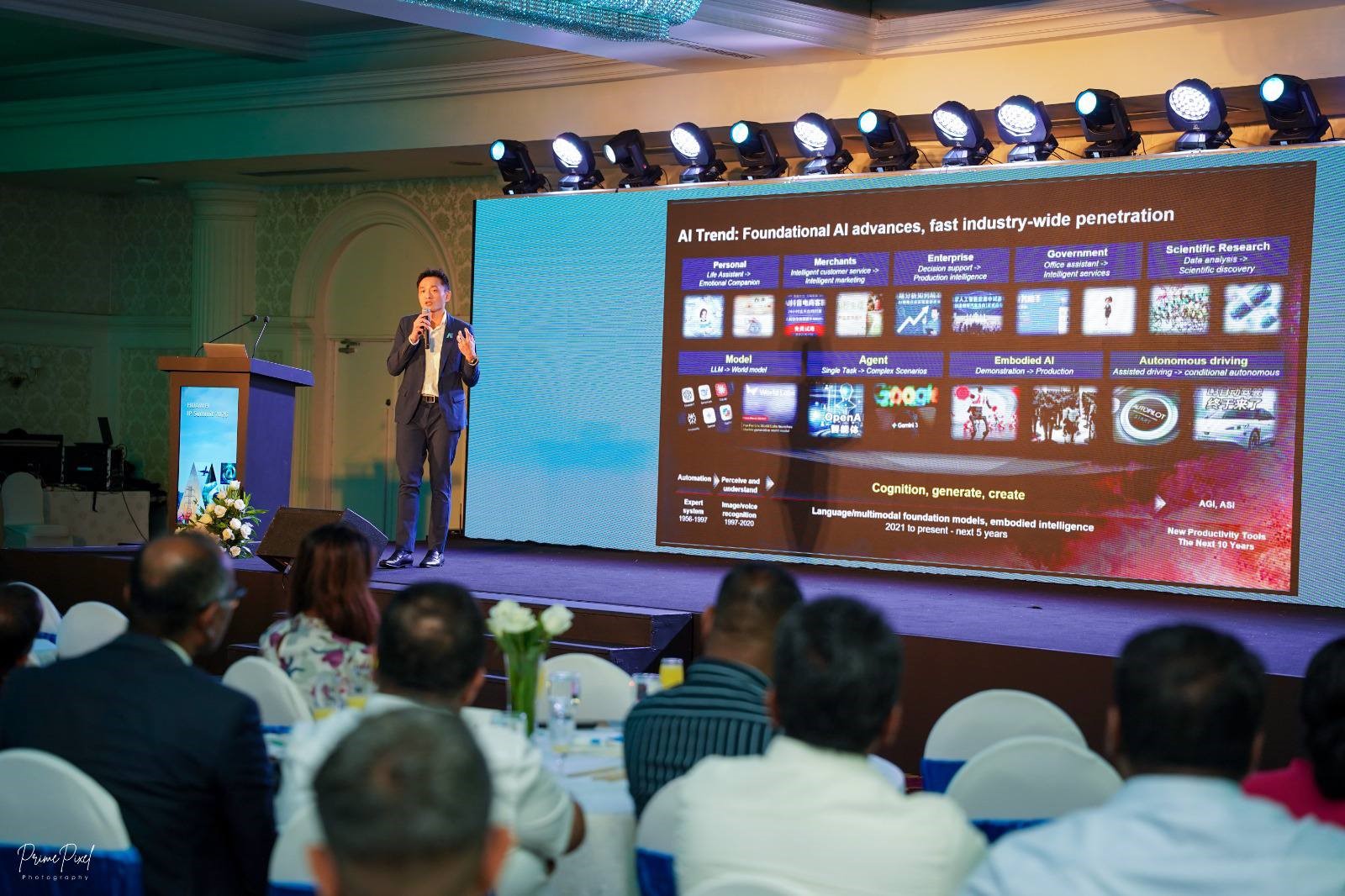
Huawei recently convened its Intelligent IP Summit 2026 in Sri Lanka, gathering technology leaders, industry practitioners, and enterprise decision-makers to examine what it will take for organisations across the country to thrive in a landscape increasingly defined by artificial intelligence and next-generation connectivity. The event positioned enterprise data communication networks not as supporting infrastructure, but as the foundational layer upon which Sri Lanka’s broader digital transformation will be built or constrained.
The summit drew participants from a wide cross-section of the economy, including banking and financial services, government and public administration, education, manufacturing, real estate, and corporate enterprise. The breadth of that representation was itself a signal: the conversation around intelligent networks is no longer confined to the technology sector. It is a strategic concern for every institution that depends on digital systems to operate, serve, and compete.
Beyond Connectivity: The Case for Intelligent Network Architecture
A central argument that ran through the summit’s proceedings was that Sri Lanka’s organisations have moved past the point where basic connectivity is sufficient. The demands of cloud computing, real-time digital services, and artificial intelligence workloads require something more integrated and more purposeful: network architectures that combine campus-level infrastructure, data centre capacity, and security frameworks into a coherent, intelligent system.
This is not an incremental evolution. As artificial intelligence applications become embedded in core business operations, the networks supporting them must be capable of handling high volumes of data with minimal latency, while maintaining the resilience and security that mission-critical environments require. The summit made the case that organisations which underinvest in this foundation will find themselves unable to extract meaningful value from the more visible layers of their digital strategies, regardless of how advanced those strategies may appear on paper.
5G and the Infrastructure That Must Support It
Sri Lanka’s ongoing progress in 5G deployment featured prominently in the summit’s discussions, though not in the way such announcements typically do. Rather than celebrating the rollout as an end in itself, industry experts at the event were candid about the conditions necessary for 5G to deliver on its promise. The technology’s capacity for speed and low-latency connectivity is real, but its value to enterprises depends entirely on the strength of the underlying data communication infrastructure.
From digital banking and electronic government services to smart manufacturing and intelligent building management, the applications that 5G enables are only as effective as the enterprise networks through which they are delivered. Huawei’s position, articulated consistently throughout the event, was that enterprise data communication serves as the critical bridge between 5G capability and real-world application, ensuring that the two ends of the technology stack meet in a way that is secure, scalable, and fit for purpose.
The Huawei Sri Lanka Chief Executive, in his remarks to the summit, described the company’s role across both dimensions of this challenge. “Huawei has long been a trusted partner in building Sri Lanka’s telecom infrastructure, playing a leading role in enabling nationwide connectivity and supporting the rollout of 5G with local operators,” he said. “At the same time, we are strengthening our position in the enterprise space, working closely with sectors such as banking and finance, government, corporates, education, manufacturing, and real estate to deliver secure, intelligent, and future-ready network solutions.”
A New Generation of Enterprise Products
The summit also served as a platform for the introduction of Huawei’s latest enterprise data communication product portfolio, each element designed with artificial intelligence readiness and operational resilience as primary requirements.
The NetEngine AR 5G Secure Router enables enterprises to integrate 5G connectivity directly into their existing network architecture, providing secure and high-speed access for organisations operating across distributed locations. For enterprises managing multiple sites or increasingly mobile workforces, the ability to build 5G capability into the network fabric rather than treating it as a separate layer represents a meaningful operational advance.
Huawei also introduced the AirEngine 8771-X1T, a Pre-Wi-Fi 8 access point that brings significant improvements in wireless speed, reliability, and mobility support. Designed specifically for artificial intelligence era demands, the device is intended to elevate enterprise wireless networks from a convenience infrastructure to a production-grade platform capable of supporting demanding applications at scale.
Complementing these was the CloudEngine twin switch series, built on a dual-plane architecture engineered for environments where downtime carries serious consequences. With zero-downtime operation, rapid fault recovery, and uninterrupted service continuity as its defining characteristics, the product is positioned as essential infrastructure for banking systems, government services, and other environments where network failure is not an acceptable outcome.
Together, these products reflect a coherent vision: that enterprise networks must now be designed not around present requirements, but around the artificial intelligence workloads and real-time service demands that will define the next phase of digital operations.
Industry Voices and a Shared Direction
A panel discussion brought together practitioners and technology leaders from financial services, telecommunications, public sector institutions, and enterprise industries to examine the practical dimensions of this transition. The conversation addressed the genuine challenges organisations face in adopting artificial intelligence-driven networks and 5G-enabled services, moving beyond product showcases to the harder questions of implementation, investment, and organisational readiness.
A consistent theme across the panel was the importance of collaboration between industry stakeholders. No single organisation, and no single technology provider, can accelerate Sri Lanka’s digital evolution in isolation. The institutional connections, shared standards, and knowledge transfer that come from sustained engagement between the public sector, private enterprise, and technology partners will determine whether the country’s digital infrastructure ambitions translate into lasting economic outcomes.
Infrastructure as National Strategy
Taken together, the Intelligent IP Summit 2026 made an argument that deserves to be heard well beyond the technology community. As Sri Lanka pursues a more connected and intelligent economic future, the decisions made now about enterprise network architecture will shape the ceiling of what becomes possible across every sector.
The convergence of artificial intelligence, 5G, and advanced network infrastructure is not a distant prospect. It is already redefining how financial institutions manage risk, how governments deliver services, and how manufacturers optimise production. Sri Lanka has the opportunity to build the foundation that makes those possibilities real, provided that investment in enterprise data communication infrastructure is treated not as a technology line item, but as a matter of national development strategy.