



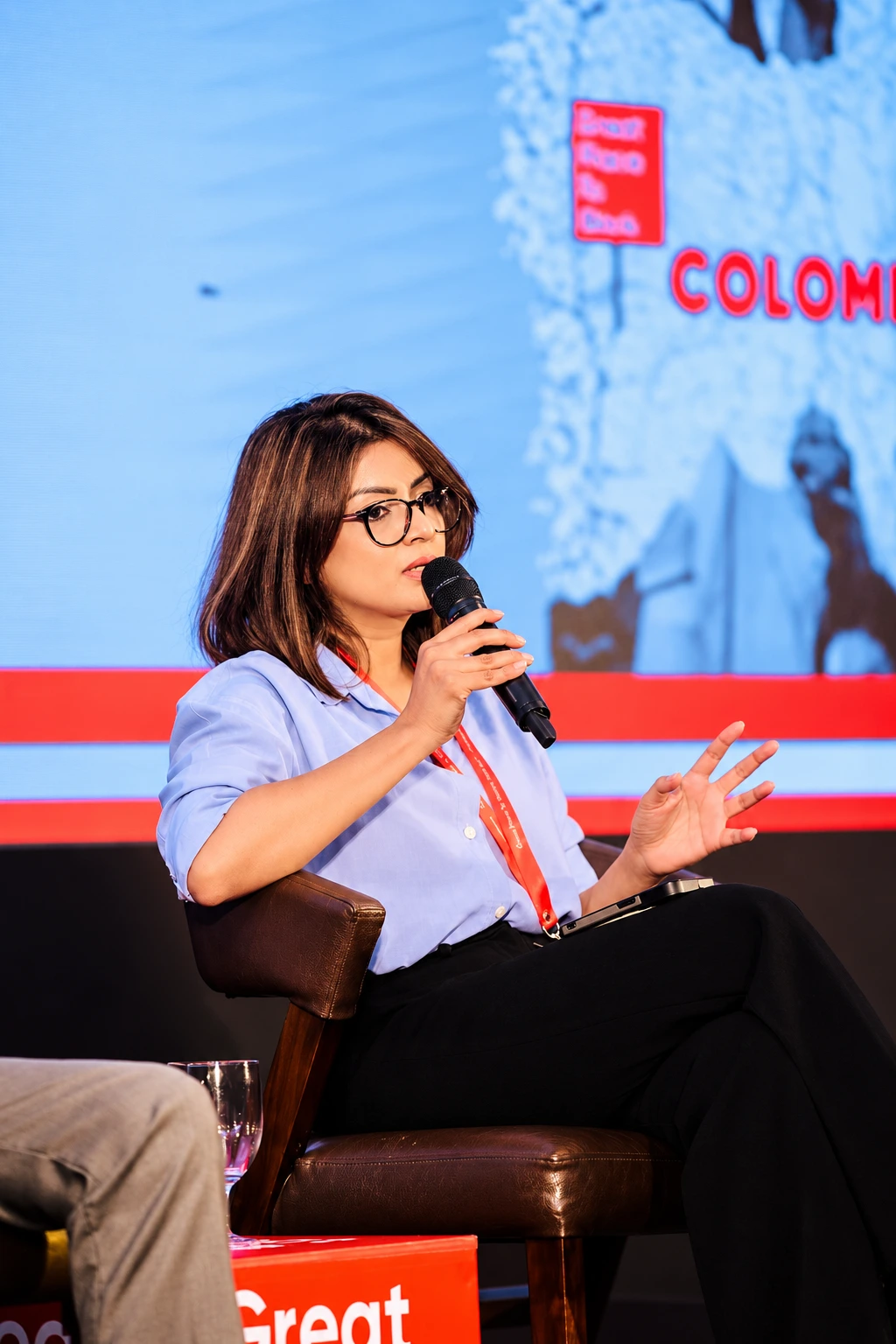
Chathini Uduwana, Country Head and Vice President of Typefi Systems Sri Lanka, is a technology and organisational development leader with experience spanning business IT, project management, technology operations and people development.
Her work has focused on building and managing technology teams, strengthening organisational capabilities and supporting Sri Lankan talent in working with global organisations.
She is a former Country Ambassador for Women in Tech Sri Lanka, and is passionate about improving opportunities for women in technology and strengthening the connection between education and industry.
What were the biggest challenges in building a global technology operation in Sri Lanka, and what did you learn about what makes a Sri Lankan tech team succeed internationally?
One of the biggest challenges initially was finding people with experience in niche technologies. Although Sri Lanka had strong technical talent, finding people with expertise in certain areas was difficult. For example, we had to find C++ engineers, which was challenging at the time. We also needed people who knew XSLT, a language used to transform XML documents, and those skills were scarce in Sri Lanka.
We had to recruit people and train them ourselves. Initially, I did not realise how limited the availability of certain niche skills was in Sri Lanka.
Another challenge remains relevant even today. Technical competency alone is not enough when you are working for a multinational organisation with people from different countries and cultural backgrounds. To succeed in a global environment, people need strong communication skills, accountability and cultural awareness alongside technical expertise.
From your experience managing technology professionals in Sri Lanka, where do you think the biggest mismatch exists between what the industry needs and what our education system produces?
Our education system is still good at producing people who can learn, but it does not necessarily produce people who are ready for the modern technology workplace.
I don’t think the biggest gap is technical knowledge. Technical knowledge can be learned, and it changes constantly. The more significant gap is in communication, business understanding, collaboration and independent thinking.
There is also a need for greater confidence to challenge an idea rather than simply accepting instructions. In many Western work environments, questioning why something needs to be done is encouraged. People are expected to discuss an issue and reach a common understanding.
Our engineers can sometimes enter the workplace with the mindset of, “Give me the instructions and I’ll do the job.” This is not necessarily an attitude problem; it is how many people have been trained through the education system, where questioning is not always encouraged.
Students may graduate with technical knowledge but still need to learn how to write professional emails, participate effectively in meetings and ask questions.
Over time, I have learned that Sri Lankan engineers can compete extremely well internationally when they are given ownership of an account or business problem rather than simply assigned tasks. However, reaching that level can take two to three years of development. Organisations need to create environments where people understand the business problem and communicate directly with global colleagues.
There is a lot of discussion about Sri Lanka becoming a global technology and knowledge-services hub. What do you think Sri Lanka is genuinely good at today, and what capabilities do we still need to develop?
If Sri Lanka wants to become a global IT hub, the first requirement is infrastructure. When a foreign company wants to establish a business here, processes such as business registration, taxation and legal requirements should be straightforward. There should ideally be a single place where companies can access all the information they need.
I don’t think Sri Lanka should try to compete with India on scale. Our engineers are not the cheapest option, so we need to be clear about the value we offer. We should focus on high-value, specialised knowledge work rather than competing on quantity and cost.
We have a relatively well-educated workforce, strong English capability, adaptability and the ability to work effectively across cultures. These are areas where Sri Lanka has an advantage.
However, we need deeper specialist capabilities in emerging areas such as AI, data, cybersecurity and advanced software engineering. We also need stronger links between universities and industry and a much stronger international positioning strategy.
Being good is not enough if the global market does not know what we are good at. I see an opportunity for Sri Lanka to position itself as a small but highly sophisticated technology and knowledge hub.
You have spoken about gender bias and stereotypes in the technology industry. Looking back at your own career, was there a particular moment when you realised that being a woman in a leadership position required you to navigate the industry differently?
One thing I initially believed was that if I worked hard, performed well and produced results, those results would speak for themselves. Over time, I realised that leadership does not work entirely that way.
Women can also face contradictory expectations. For me, what became increasingly important was being consistent, competent and authentic.
When we talk about gender equality, the question should not simply be how we help women enter the technology industry. We also need to ask whether companies allow different kinds of people to progress, lead and succeed without requiring them to fit a narrow stereotype of what a leader should look or behave like.
What are Sri Lankan companies getting wrong when it comes to retaining and advancing female technology professionals?
There has traditionally been a focus on recruitment numbers. Some companies may have 40% or 50% women among their new recruits, but the more important question is what happens to those women over the next 10 years.
How many become technical leads? How many reach senior management? How many enter executive leadership?
We need to monitor progression and retention, not just recruitment. Getting women into the industry is only the beginning.
As someone involved with Women in Tech Sri Lanka, where do you believe the biggest intervention is needed today?
If I had to choose one area, I would choose the workplace and corporate leadership.
Schools and universities are extremely important, but Sri Lanka already produces capable and educated women. The problem is that women’s participation and representation decline as their careers progress.
That tells us that this cannot be treated purely as an educational pipeline problem. It is also a societal and organisational issue.
Corporate leaders determine who gets promoted, who receives high-visibility assignments, whether flexibility damages someone’s career and ultimately who gets access to leadership.
We need to move the conversation from simply encouraging girls to enter STEM (Science, Technology, Engineering and Mathematics) towards creating environments where women can remain, progress and lead in STEM.
Do you believe AI will ultimately widen Sri Lanka’s technology talent gap, or could it help us overcome some of our existing talent constraints?
It could potentially do both. AI will make some skills less valuable while dramatically increasing the value of others. This could create a larger divide between professionals who know how to work with AI and those who do not. This applies across professions, not only technology.
For Sri Lanka, however, I see AI as an opportunity. One of the biggest limitations in our technology industry is scaling. AI gives us the ability to scale more effectively. A highly skilled team can now accomplish things that previously required a much larger workforce and greater resources.
But we should not confuse using ChatGPT or cloud services with being AI-ready.
We need people who understand data, AI systems, domain applications, validation and ethics, as well as how to combine human expertise with AI capabilities.
Being AI-ready means developing the capabilities to work effectively with AI.
How important is it for technology leaders to understand the business side of technology rather than simply the technical side?
Technology is fundamentally about problem-solving. I don’t see technology as an isolated function anymore. It sits at the intersection of customers, people, business processes, strategy and commercial outcomes.
The more senior you become, the less your role is about knowing every technical detail yourself. Your role becomes more about asking the right questions, understanding problems, developing people, making technology decisions and aligning those decisions with organisational strategy.
The best technology leaders therefore need to be bilingual, in a sense: they need to speak technology and speak business.
From your experience working with an international technology organisation, has remote work made Sri Lankan talent more competitive globally or made retention more difficult?
Remote work has removed a major geographical barrier. Today, without needing a visa, Sri Lankan professionals can work for companies in Europe, the US, Australia and other markets.
It has given Sri Lankan professionals much greater global accessibility. Previously, someone might have had to leave the country to access those opportunities. Now they can potentially access them remotely.
At the same time, this means Sri Lankan companies have to compete with employers from around the world for talent.
Which leadership lesson took you the longest to learn, and what do you wish you had understood when you first entered the technology industry?
One lesson is that leadership is fluid. When I was younger, I had an idea of the kind of leader I wanted to be. Later, I realised you cannot simply define yourself as a transformational leader or a visionary leader.
Leadership changes according to the situation. At one point you may need to be more directive, while in another situation you may need to be diplomatic or transformational. You adapt the way you lead according to the circumstances.
The other lesson is that leadership is about creating the conditions in which other people can make good decisions. That requires trust and dedication, and sometimes it means allowing someone to approach a problem differently from the way you would approach it.
These are lessons that come through experience. Knowing leadership theory and applying it in real situations are two different things.
If you were given responsibility for designing a five-year strategy to make Sri Lanka a more competitive technology destination, particularly for women and young professionals, what would you change first?
First, I would radically strengthen the connection between education and industry.
Universities produce research and add to the knowledge pool, but that research does not always have commercial value. There needs to be a much stronger understanding of what has value in the commercial sector.
Other countries have technology parks where universities and organisations operate alongside each other, with open-door policies, internships and access to laboratories. Sri Lanka needs stronger models of this kind.
Universities and companies should jointly design industry projects, internships, research programmes, emerging technology workshops and curricula. Students should encounter real business problems through simulations or practical projects long before graduation.
Second, we should build specialised national capabilities rather than trying to compete everywhere. We should identify areas where Sri Lanka can develop internationally credible expertise and build around those niches.
Third, we need to expand opportunities beyond Colombo. We talk about startups, entrepreneurship and technology opportunities, but these initiatives are still heavily concentrated in Colombo even though there is talent throughout the country.
We need better pathways into technology and stronger opportunities for continuous reskilling so that thousands of capable people can participate in the digital economy.
The goal should not simply be to create more IT jobs. We should be creating higher-value intellectual property, products, companies and expertise from Sri Lanka.
We also need policies and infrastructure that make it easier to establish companies and attract foreign direct investment. The government should have better data on how many graduates we are producing, the quality of those graduates and the available job market.
Investors and policymakers need access to current information and dashboards rather than relying on outdated data.
When you look at the next five to 10 years of Sri Lanka’s technology industry, what genuinely worries you, and what are you most optimistic about?
One concern is that we could focus too heavily on adopting technology without developing the intellectual capability behind it.
There is a big difference between being consumers of AI and being creators of AI-enabled value. If our education system, organisations and policies do not evolve quickly enough, we could end up with a small group of highly advanced professionals alongside a much larger workforce whose skills are becoming less relevant.
Going forward, it is not just about AI adoption. It is about human capability development. Technology will continue to change, but countries that succeed will be those whose people are capable of changing with it and, ideally, helping shape where it goes next.
We need to develop an AI-enabled mindset rather than simply focusing on how to use AI.
On the optimistic side, emerging technologies present a major opportunity. For a small country like Sri Lanka, having access to the global technology landscape can be transformative.
Our people, organisations and developers can access technologies and markets around the world. A technology entrepreneur does not necessarily have to market a product only in Sri Lanka. An engineer’s opportunities are also global.
That global accessibility is something I find very encouraging.