



Close Menu

    Subscribe to Updates

    Get the latest creative news from FooBar about art, design and business.

    What's Hot

    What comes after chatbots? Are AI agents the next big shift in enterprise software?

    October 23, 2026

    What is PHP and why did it spark a global cyber-security scramble?

    October 22, 2026

    Kings Hospital Colombo Completes Sri Lanka’s First Two Robotic Telesurgeries

    October 22, 2026
    Facebook X (Twitter) LinkedIn
    Trending
    • What comes after chatbots? Are AI agents the next big shift in enterprise software?
    • What is PHP and why did it spark a global cyber-security scramble?
    • Kings Hospital Colombo Completes Sri Lanka’s First Two Robotic Telesurgeries
    • ‘Your TV should do what you paid for’
    • Passkeys vs Passwords: Is It Time to Stop Using Passwords?
    • 5m digitally skilled Sri Lankans by 2030: PM Harini endorses CSSL’s ‘National Workforce Agenda’
    • The road to hell is paved with AI flyers
    • ‘They’re not dead yet’: Bleached corals recover in record time after touching healthy clones
    Facebook X (Twitter) LinkedIn
    Techie.LKTechie.LK
    Demo
    • Home
    • Local
      1. AI & Machine Learning
      2. Consumer Tech
      3. Cybersecurity
      4. Enterprise Tech
      5. Fintech & Digital Payments
      6. GovTech & e-Governance
      7. Legal & Regulatory Tech
      8. Science & Innovation
      9. Startups & Venture
      10. Telecom & Connectivity
      Featured

      Kings Hospital Colombo Completes Sri Lanka’s First Two Robotic Telesurgeries

      By Techie.lkOctober 22, 20263
      Recent

      Kings Hospital Colombo Completes Sri Lanka’s First Two Robotic Telesurgeries

      October 22, 2026

      5m digitally skilled Sri Lankans by 2030: PM Harini endorses CSSL’s ‘National Workforce Agenda’

      October 21, 2026

      Sri Lanka must create technology, not just consume it, says PM

      October 19, 2026
    • International
      • AI & Machine Learning
      • Consumer Tech
      • Cybersecurity
      • Enterprise Tech
      • Fintech & Digital Payments
      • GovTech & e-Governance
      • Legal & Regulatory Tech
      • Science & Innovation
      • Startups & Venture
      • Telecom & Connectivity
    • Interviews
    • Profiles
    • Analysis
    • Contributors
    • Podcasts
    • More
      • About Us
      • Contact Us
    Techie.LKTechie.LK
    Home»International»‘They’re not dead yet’: Bleached corals recover in record time after touching healthy clones
    International

    ‘They’re not dead yet’: Bleached corals recover in record time after touching healthy clones

    Techie.lkBy Techie.lkOctober 21, 2026Updated:October 23, 2026No Comments5 Views
    Facebook Twitter LinkedIn WhatsApp Reddit Tumblr Email
    coral
    Share
    Facebook Twitter LinkedIn

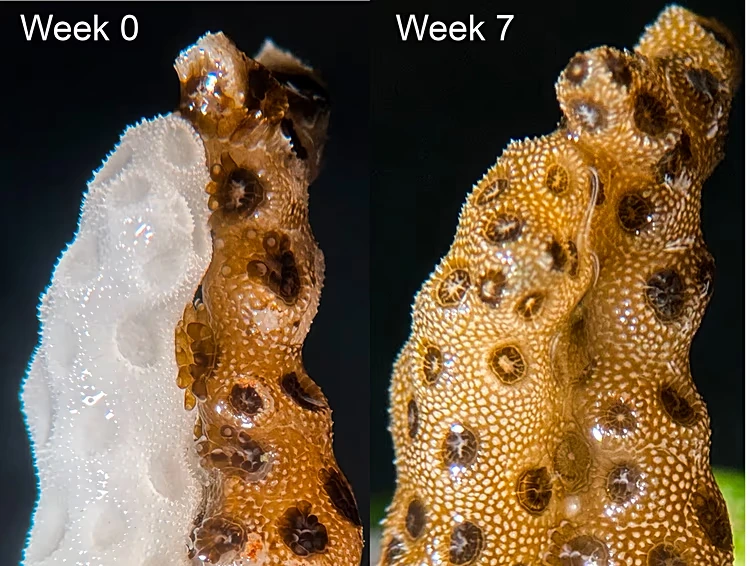
    In the lab, bleached corals recovered within just seven weeks of being put in brief contact with healthy corals

    Dying corals may have found an unexpected lifeline: their neighbours.

    Scientists at Stanford University have discovered a way to bring corals back from the brink of death by placing them in contact with healthy corals for just a few days.

    Published in Science Advances, the study presents a promising new approach to restoring coral reefs as rising sea temperatures cause more frequent and severe coral bleaching events.

    When water becomes too hot, corals expel the microscopic algae that provide much of their energy, an event known as bleaching, which leaves them vulnerable to starvation.

    After bleaching events, it can take months or years for surviving corals to recover – but the scientists contend hope is not lost for them.

    “While bleached corals may be dying, they are not dead yet,” says lead author Danny Collins, a PhD student at Stanford. “The question we wanted to answer is, once a coral has bleached, what can we do?”

    How scientists brought bleached corals back to full strength

    The discovery happened by accident in 2025, when Steve Palumbi, a professor of oceans and marine biologist at Stanford’s Doerr School of Sustainability, noticed two pieces of coral that had fallen against each other in a laboratory tank. One was healthy while the other was bleached. But where the two touched, the bleached coral was beginning to regain its colour.

    Collins then arranged 10 pairs of coral fragments, each containing a healthy and bleached piece from the same colony. Five pairs were placed in contact with one another, and the others were kept a few millimetres apart.

    Within seven weeks, all five bleached fragments put in contact with their healthy clones had recovered. The ones that were kept apart had died.

    Under a microscope, the scientists discovered the corals had fused together, creating tiny channels that allowed algae and nutrients to pass from one to the other. Within three days, beneficial algae had begun moving from the healthy corals into the bleached ones. After about a week, some had received enough algae to recover on their own.

    Once inside the damaged corals, the beneficial algae began multiplying rapidly. “They flood in and start dividing at the fastest rates seen in corals,” says Palumbi.

    During the second week, the algae doubled in number every four days – about 10 times faster than in wild corals – allowing the damaged corals to continue recovering even after they were separated from the healthy ones.

    The finding marked a breakthrough in the lab. “Bleached corals are often considered a lost cause because recovery after a heatwave is very slow, if it happens at all,” says Fiorenza Micheli, a Stanford professor and one of Collins’ faculty advisors.

    But the scientists say the technique isn’t ready for wide-scale application in the oceans.

    The corals must be genetically identical for their tissues to fuse. In other words, every damaged coral would need a healthy copy of itself – an impractical solution for restoring whole reefs. But the researchers hope to find ways to deliver the beneficial algae without requiring direct contact or identical twins.

    Coral reefs may be running out of recovery time

    The revelation comes at a crucial time for coral reefs.

    According to the Global Coral Reef Monitoring Network’s latest assessment, the world’s reefs have lost nearly 10 per cent of their living coral over the past four decades. Between 2023 and 2024 alone, it fell almost 9 per cent during a global bleaching event – the largest single-year decline ever recorded.

    Global bleaching now occurs roughly every five to six years, leaving reefs less time to recover between bouts of extreme heat. The report warns that reefs will continue declining unless man-made emissions fall and threats such as overfishing, water pollution and coastal developments are curbed.

    And while combining coral to help them recover from bleaching might save some of them, Palumbi stresses that it can’t protect them from rising sea temperatures.

    “This is a recovery story. It doesn’t blunt heatwaves; it just helps the aftermath. There is still a huge need to reduce heatwaves and protect all of Earth’s life from rapid climate stress,” he says.

    “Eventually, it can hopefully help the huge effort being put into restoration succeed better by helping those coral gardens survive heatwaves more completely.”

    Featured image credit: Danny Collins

    (EuroNews)
    Top News Top Posts
    Share. Facebook Twitter LinkedIn
    Techie.lk
    • Website

    Related Posts

    What is PHP and why did it spark a global cyber-security scramble?

    October 22, 2026

    Kings Hospital Colombo Completes Sri Lanka’s First Two Robotic Telesurgeries

    October 22, 2026

    ‘Your TV should do what you paid for’

    October 22, 2026
    Leave A Reply Cancel Reply

    Demo
    Top Posts

    Chadika Yahampath: Head of Digital Capacity Building, GovTech Sri Lanka

    September 21, 2026291

    The Exit Plan: The Leadership Lessons No Startup Can Afford to Ignore

    August 18, 2026215

    Solve a Global Problem from Sri Lanka: Haridhu Abeygoonaratne on Building a Product Nation

    October 6, 2026118

    The Death of the Traditional Software Engineer: Bridging the Talent Gap in the Post-AI Era

    August 10, 2026113
    Don't Miss
    Contributors

    What comes after chatbots? Are AI agents the next big shift in enterprise software?

    By Techie.lkOctober 23, 20266

    By Chulanga Averil Hettiarachchi For more than three decades, enterprise software has operated on one…

    What is PHP and why did it spark a global cyber-security scramble?

    October 22, 2026

    Kings Hospital Colombo Completes Sri Lanka’s First Two Robotic Telesurgeries

    October 22, 2026

    ‘Your TV should do what you paid for’

    October 22, 2026
    Stay In Touch
    • Facebook
    • Twitter
    • LinkedIn

    Subscribe to Updates

    Get the latest creative news from SmartMag about art & design.

    Demo
    About Us
    About Us

    Your source for the lifestyle news. This demo is crafted specifically to exhibit the use of the theme as a lifestyle site. Visit our main page for more demos.

    We're accepting new partnerships right now.

    Email Us: techielkeditor@gmail.com
    Contact: +94 77 328 0773

    Facebook X (Twitter) LinkedIn
    Our Picks

    What comes after chatbots? Are AI agents the next big shift in enterprise software?

    October 23, 2026

    What is PHP and why did it spark a global cyber-security scramble?

    October 22, 2026

    Kings Hospital Colombo Completes Sri Lanka’s First Two Robotic Telesurgeries

    October 22, 2026
    Most Popular

    Chadika Yahampath: Head of Digital Capacity Building, GovTech Sri Lanka

    September 21, 2026291

    The Exit Plan: The Leadership Lessons No Startup Can Afford to Ignore

    August 18, 2026215

    Solve a Global Problem from Sri Lanka: Haridhu Abeygoonaratne on Building a Product Nation

    October 6, 2026118
    © 2026 Techie. Designed by NIKO.
    • Terms & Conditions
    • Privacy Policy

    Type above and press Enter to search. Press Esc to cancel.