



By Chulanga Averil Hettiarachchi
For more than three decades, enterprise software has operated on one fundamental assumption:
People use the software.
Employees open ERP systems to create purchase orders. Sales teams update CRM records. Finance teams process transactions. Service teams manage tickets, schedules and reports.
We have spent decades making these systems faster, smarter and easier to use.
But the next shift may be different.
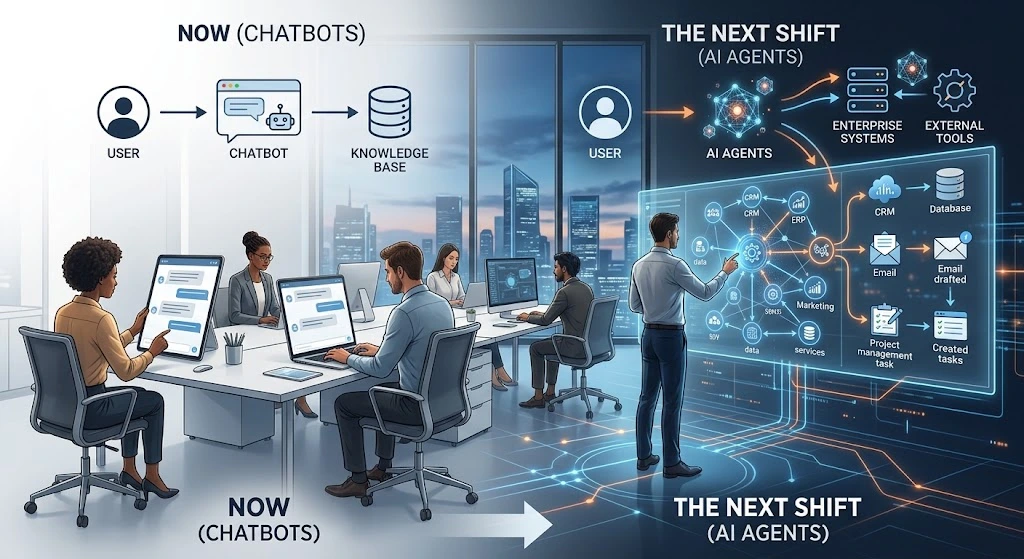
Instead of people operating software, software may increasingly operate on their behalf.
This is where AI agents enter the picture.
From Asking AI Chatbots to Giving AI Agents a Job
From asking AI to giving AI a job
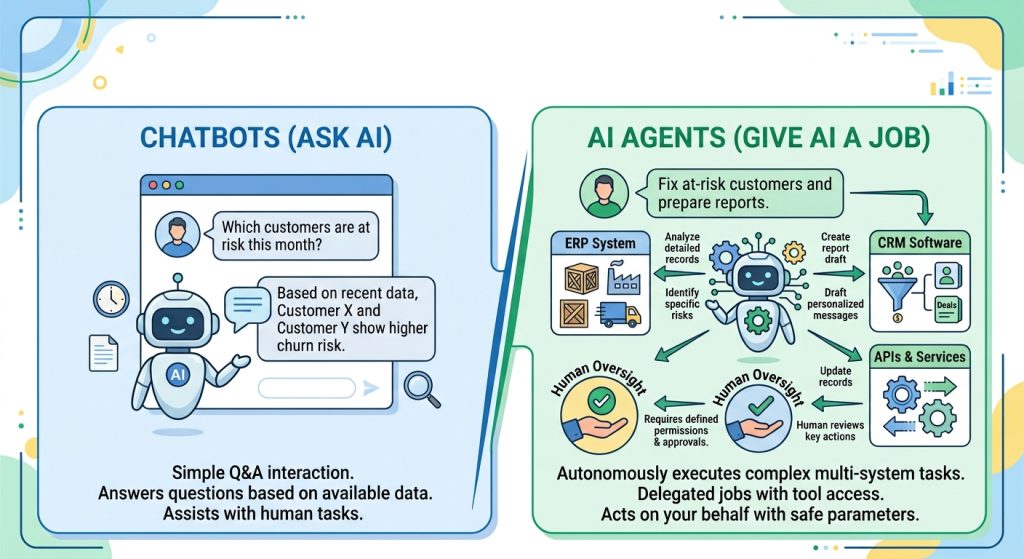
Visual credit: AI-generated using Google Gemini; concept and editorial content by the author.
A chatbot answers a question.
An AI agent can be given a job.
Ask an AI assistant, “Which customers are at risk this month?” and it might analyse the available information and provide an answer.
An agent could go further.
It could examine customer records, service history and previous interactions, identify potential risks, prepare a report, draft follow up messages and update relevant systems subject to the permissions and human approvals defined by the organisation.
The distinction is important:
An assistant helps you do the work. An agent can do parts of the work for you.
Recent enterprise research reflects this shift from assistance toward delegated, tool-connected work. OpenAI’s December 2025 enterprise report, for example, describes organisations using AI in more sophisticated ways, not just more often.
Gartner has predicted that up to 40% of enterprise applications could include task specific AI agents by the end of 2026, compared with less than 5% in 2025.
That is more than another software feature.
It represents a different way of interacting with technology.
The software interface may become less important
Enterprise software has traditionally competed through interfaces.
Better dashboards.
Better menus.
Faster workflows.
More integrations.
But what happens when an employee can simply state an outcome?
“Prepare this month’s sales forecast.”
“Find overdue customer payments and draft follow ups.”
“Schedule technicians for these service requests.”
“Compare inventory against upcoming demand.”
The employee may no longer need to open five different applications to accomplish the task.
The agent becomes the layer between the employee and the software.
Gartner calls this agentic arbitrage: AI agents can perform work across multiple systems, potentially reducing the need for users to interact directly with each application’s interface. Gartner estimates that up to $234 billions of enterprise application spending could be exposed to this shift through 2030.
The ERP, CRM or service management platform does not necessarily disappear.
But the way people interact with it may change.
The future of enterprise software may involve less interaction with software, not more.
The real revolution is integration
This is where the conversation becomes more interesting.
An intelligent agent is only as useful as the systems and information it can safely access.
If the data is unreliable, the agent is unreliable.
If APIs are restricted, the agent cannot do much.
If permissions are poorly designed, the agent can do too much.
And if business processes are unclear, automation simply makes bad processes happen faster.
The architecture of enterprise AI therefore becomes critical:
Employee → AI Agent → Enterprise Data → APIs → Business Systems → Action → Human Oversight
This is why ERP, CRM, APIs, identity management and integration architecture are not becoming less important in an agentic world.
They may become even more important.
An agent needs somewhere to get information, somewhere to act, and clearly defined boundaries around what it is allowed to do.
In other words, the value of an AI agent is not determined by the model alone.
It depends on the ecosystem around the model.
But there is a problem
There is a fundamental difference between AI that answers and AI that acts.
A wrong answer can be corrected.
A wrong action may already have consequences.
An agent could send the wrong email, update the wrong customer record, trigger an incorrect transaction or expose information to someone who should not have access.
That makes AI governance part of the architecture not an afterthought.
Who decides what an agent can access?
Which actions require approval?
Who is accountable when something goes wrong?
How are actions recorded and audited?
Where does a human take over?
These questions become increasingly important as agents move from answering questions to executing business processes.
Gartner has warned that organisations need governance appropriate to an agent’s level of autonomy and access. It predicts that by 2027, 40% of enterprises could demote or decommission autonomous AI agents because of governance gaps discovered after production incidents.
The goal, therefore, should not be maximum autonomy.
It should be maximum useful autonomy.
What should businesses do now?
Companies do not need an AI agent for everything.
The better starting point is to identify processes that are repetitive, measurable, reasonably structured and valuable enough to automate.
Potential examples include:
- Customer service triage
- Report preparation
- Sales follow-ups
- Document processing
- Inventory analysis
- Scheduling
- Internal knowledge retrieval
But the first question should not be:
“Where can we put AI?”
It should be:
“Which business process could we safely delegate?”
That is a much more useful question.
Start with the workflow, not the technology.
Understand the process. Identify the decisions involved. Determine what data and systems are required. Define permissions and approval points. Then decide where an AI agent can add value.
From software users to software supervisors
The biggest change may not be technological at all.
It may be the changing role of people.
Employees may spend less time clicking through applications and more time defining objectives, reviewing outcomes, handling exceptions and supervising AI-driven workflows.
Developers will need to build systems that agents can interact with safely.
Business analysts will need to understand human-agent workflows.
Project managers will increasingly coordinate people, technology and automated systems.
Technology leaders will need to decide where machines can act and where humans must remain in control.
For decades, enterprise software was designed around the idea of people using systems.
The agentic era introduces a different possibility:
People define the outcome. Intelligent systems increasingly execute the work.
The chatbot era taught us to ask AI questions.
The agentic era may teach us to give AI responsibility.
And that could change what enterprise software is designed to do in the first place.
The future may not be about building better software for people to operate.
It may be about building better systems that people can trust to operate on their behalf.