



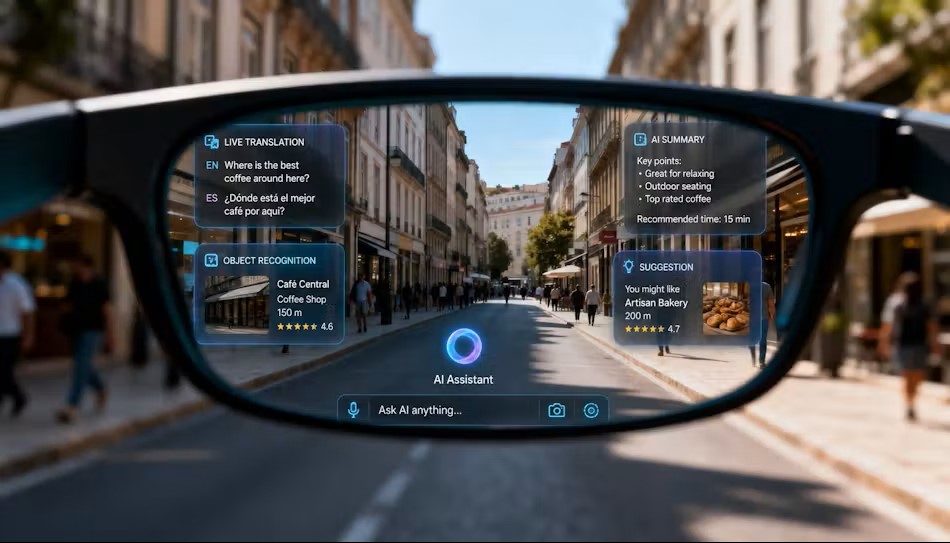
Artificial intelligence (AI) doesn’t replace the traditional metrics of augmented-reality (AR) optical performance, but it does change how optical engineers prioritize and balance them as the role of an AR optical system for smart glasses shifts from occasional display to a persistent communication interface between users and AI assistants.
For optical engineers, the rapid development of AI-enabled smart glasses is changing more than the applications optical systems must support—it’s altering how AR optical systems are evaluated.
AR optical development has primarily focused on familiar engineering objectives: Brightness, field of view, image quality, weight, power efficiency, and manufacturability. But AI assistants create a different usage model—one in which users may rely on the display repeatedly throughout the day for navigation, translation, reminders, contextual information, and brief interactions.
This shift is already visible within the market. AI smart glasses accounted for 88% of global smart-glasses shipments in the second half of 2025, according to Counterpoint Research, while total smart glasses shipments increased 139% year over year during the same period. Within the AR segment, counterpoint reports shipments of waveguide-based devices increased more than 600% year over year during the second half of 2025.
For optical engineers, these trends are significant because they indicate AI and waveguide-based displays are increasingly converging in commercial products—and it makes the relationship between AI interaction models and optical system performance more than simply a theoretical engineering question.
Designers increasingly need to consider how these specifications work together to deliver information that’s immediately readable, visually comfortable, appropriately integrated with the physical environment, and practical for extended everyday use.
AI won’t replace the traditional metrics of AR optical performance, but it does change how optical engineers must prioritize and balance them.
Performance metric #1: Continuous information display
AI changes an important aspect of optical system design—the frequency and duration of interaction with the display. Earlier generations of AR devices were designed around discrete applications or workflows. Now, AI assistants create the potential for a continuous series of interactions. Navigation prompts, translated conversations, reminders, contextual recommendations, messages, and notifications may appear briefly whenever they become relevant.
As AI systems become more proactive, information may increasingly be presented not only when users explicitly request it, but when the system determines it could be useful. This changes the role of the optical system from an occasional display into a persistent communication interface between the user and an AI assistant.
Featured image: Context-aware AR applications require optical systems to maintain readable, high-contrast information across changing real-world environments, which makes legibility and visual comfort important measures of performance.