



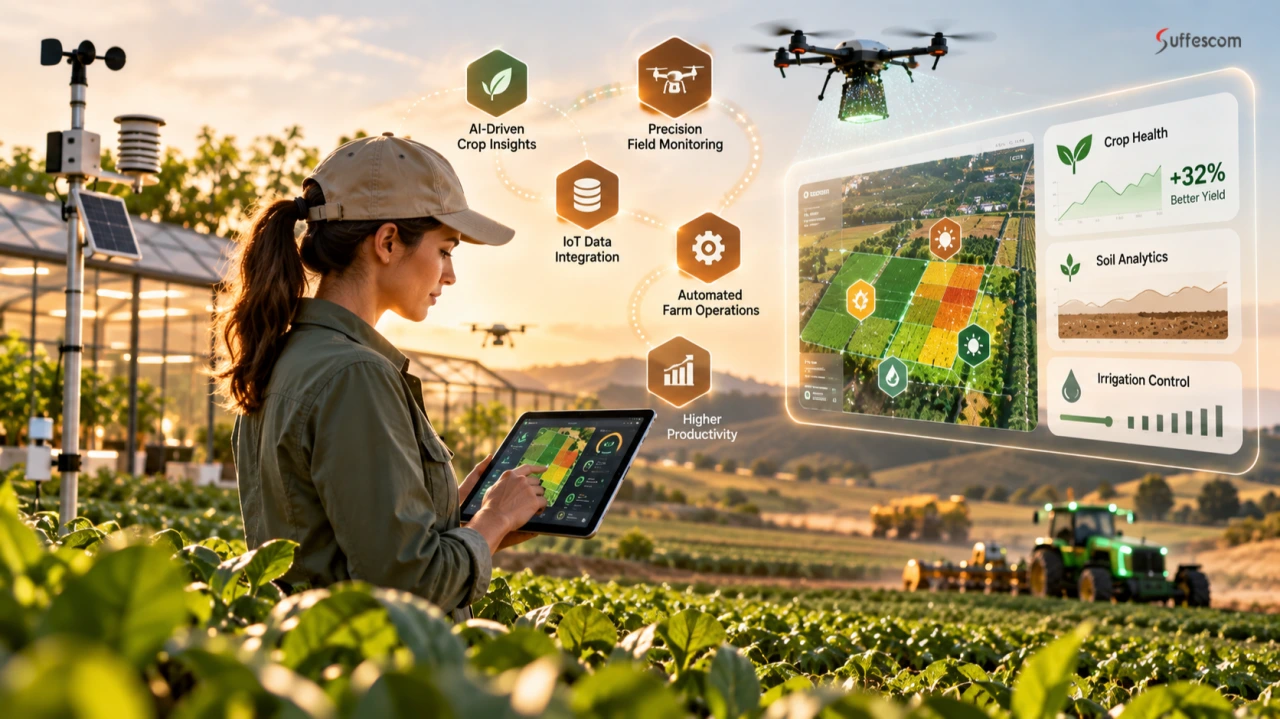
Precision agriculture is evolving from scattered sensors and limited farm management software to comprehensive software systems that can understand the context of the farm and help make decisions on the go. Soil sensors, machinery, satellite pictures, drones, weather patterns, GPS, and crop information have resulted in massive amounts of data generation. The real challenge is turning those signals into useful workflows, which is where AgriTech software development becomes increasingly important.
Grand View Research shows that the global market for precision agriculture is expected to reach $38.8 billion in 2033, up from $16.8 billion in 2026. Some of the growth drivers include IoT, big data analytics, connected machines, and geospatial technology.
When Farm Data Becomes a Software Problem
A contemporary farm gathers information about soil, weather, machinery, irrigation, GPS, drones, crops, imaging, and field management software. However, just gathering data does not mean creating precision farming. The software should standardize data from different sources, recognize patterns, generate useful insights, and connect recommendations to decisions.
According to the USDA report, adoption is advancing as follows. In 2023, autosteering was adopted by 52% of medium-sized farms and 70% of large-scale crop production farms, and yield monitors, yield maps, and soil maps were used by 68% of large-scale crop production farms.
That makes the software challenge easier to understand through four connected stages:
- Sense: Capture field, equipment, environmental, and crop information.
- Understand: Analyze those signals using analytics and AI.
- Decide: Produce forecasts, alerts, recommendations, or priorities.
- Act: Connect intelligence with irrigation, field tasks, machinery, resource planning, or management workflows.
What Has to Connect Before Precision Agriculture Actually Works?
The value of AI and IoT grows when they become elements of one agricultural system. A useful platform should make connections between the physical environment, history, business logic, geography, and work processes instead of seeing each technology as an isolated application.
Field intelligence
The state of soil moisture, temperature, nutrients, weather, crop condition, and other variables at a field form the basis of the information needed for making site-specific decisions. Software should tie this information to a specific field, crop, geographic location, time interval, and context.
Equipment intelligence
Connected tractors, harvesters, irrigators, drones, and many others can give information on location, utilization, performance, fuel, maintenance, and field operations. The integration of all these sources links decisions made for equipment with the whole farm plan.
AI decision support
Machine learning technology can be used to analyze past and current agricultural data to create yield forecasts, anomaly detection, disease risk warnings, insights on crops, advice on irrigation, and prediction of equipment maintenance needs. The critical issue here is not adding another AI-based solution but making the model better at supporting a decision.
Operational execution
The final layer turns intelligence into action. The platform may activate the irrigation process, assign field operations, notify the agronomist, create a prescription map, or update management records. Otherwise, precision agriculture remains analytics only.
10 AgriTech Software Companies Turning Agricultural Data Into Action
1. Suffescom Solutions Inc.
Suffescom Solutions Inc. specializes in custom agriculture software, agricultural IoT, AI & ML, analytics, GPS & geospatial technology, computer vision, cloud architecture, and software modernization. The agricultural skills of Suffescom Solutions Inc. also include connected sensors, weather stations, irrigation, equipment, crop monitoring, predictive analytics, dashboards, and applications for the field.
This broad range of engineering skills is essential, as a precision farming platform is not made up of one module. It might need to integrate mobile applications, APIs, cloud architecture, devices, analytics, dashboards, and integration with other enterprise systems. Thus, the software becomes the platform that combines various agricultural technologies into one operating system.
Best suited for: Custom AgriTech platforms, precision farming, agricultural IoT, AI-driven farm management, connected equipment, and integrated agricultural ecosystems.
2. Folio3 AgTech
Folio3 AgTech includes custom agricultural software along with AI, IoT, ERP, cloud, analysis, integration, and precision agriculture technologies. Folio3 AgTech’s current agricultural product line includes farm management, crop & livestock management, IoT connectivity, remote sensing, prescription maps, soil and crop health monitoring, automated yield forecasting, drone imagery, and AI/ML.
The bigger significance of Folio3 AgTech is the linking of field level systems with the business systems that surround them, which is necessary if agricultural software needs to move from monitoring to more business-oriented capabilities such as inventory, accounting, planning, compliance or enterprise processes.
Best suited for: Precision agriculture platforms, farm management, agriculture ERP, IoT integration, and AI-enabled agricultural operations.
3. Chetu
Chetu approaches the concept of smart farming from the perspective of integration. The development of precision agriculture by the company encompasses sensor software, agricultural APIs, farm management applications, big data systems, drone solutions, and interface solutions where smart-farming technology is integrated with current systems.
This integration is important in situations where the agricultural firm has different systems and devices. It would be more prudent to integrate the existing systems through APIs and other data processing methods rather than purchasing new equipment.
Best suited for: Smart-farming applications, agricultural integrations, APIs, precision data management, drone systems, and IoT-connected operations.
4. Velvetech
Velvetech covers a wide range of agricultural technology stacks ranging from farm management to crop prediction, equipment maintenance, IoT, sensors, drones, analytics, cloud, and intelligent applications in agriculture. Their approach ties in field and equipment information with software solutions to create operational and decision-making visibility.
A geospatial workflow may become highly beneficial in cases where satellite or drone data have to be analyzed along with field boundaries, crop condition, historic data, and operational data. This way, the information becomes much more actionable rather than an isolated layer of imagery.
Best suited for: Geospatial agriculture, crop intelligence, smart farming, equipment systems, IoT, and enterprise agricultural software.
5. Itransition
Itransition offers custom IoT development services in agriculture in the form of IoT-powered field and livestock monitoring, weather monitoring, analytics, and irrigation and fertilization control.
The key benefit of such an approach lies in the interaction of physical sensing and software control. For example, a sensor will give a piece of information about some condition, whereas a connected system can combine this information along with the weather data, analytics, and operational logic for the sake of better farming practices.
Best suited for: Agricultural IoT, real-time monitoring, predictive analytics, smart irrigation, and connected livestock or field systems.
6. Clustox
Clustox clearly operates within the realm of precision agriculture software, AI, Internet of Things (IoT), big-data analytics, farm management, irrigation management, crop monitoring, ERP, supply chain systems, and real-time agricultural monitoring.
This blend of technologies comprises three mutually complementary components: IoT provides current information on the fields, AI enables predictions and pattern recognition, whereas data infrastructure adds necessary historical background that makes those models relevant. This particular combination is applicable to agricultural organizations implementing decision-making systems.
Best suited for: Precision agriculture, AI-driven farming, IoT monitoring, agricultural analytics, farm management, and agriculture ERP.
7. MindK
MindK frames precision farming around an observe → diagnose → decide → act sequence. Its services in agricultural development cover areas of sensor-integrated technologies, environmental and soil monitoring, livestock-related systems, drone technologies, GPS-based systems, variable rate technologies, analytical tools, and IoT cloud platforms.
The framework described focuses on post-data collection actions. The software is made more useful because the analysis of information on soils, crops, livestock, or weather finally leads to an operational action.
Best suited for: IoT agriculture, sensor-based farming, resource optimization, GPS applications, and agricultural decision-support systems.
8. SmartTek Solutions
SmartTek Solutions integrates its AgriTech solutions with more general services in IoT, AI/ML, cloud, mobile, web, ERP, and data engineering. In addition, the company’s work in agriculture includes custom software development in the areas of precision agriculture, resource management, and agricultural analytics. Thus, SmartTek Solutions suits clients whose needs go beyond field observation.
The more general engineering approach is recommended when the agricultural platform requires integration with mobile apps, enterprise systems, business processes, or other digital platforms, instead of being a separate tool for farmers.
Best suited for: Agricultural analytics, IoT, precision agriculture, enterprise integrations, mobile applications, and connected operational systems.
9. Cloudester
Cloudester offers agriculture software including farm management, precision farming, workflow automation, agri ERP, livestock management, agriculture data management, monitoring dashboards, and IoT-integrated systems. The technology platform of Cloudester also includes agricultural databases, smart resource management, and operation monitoring.
This solution is useful where there is a requirement for transferring information from separate tools into one working environment. Data from field sensors, connected devices, weather data, enterprise solutions, and monitoring dashboards can all help in building up the integrated view of agricultural operations.
Best suited for: Farm management, precision agriculture, workflow automation, IoT integration, agricultural analytics, and enterprise agriculture platforms.
10. Biz4Group
Biz4Group provides solutions for agriculture software development with AI- and IoT-focused scenarios such as precision agriculture, monitoring crop health, yield forecasting, irrigation, livestock management, predictive analytics, connected sensors, satellite imaging, and cloud-enabled agriculture systems.
The technological approach is especially pertinent when the agricultural product must be paired with conventional engineering and machine learning capabilities. However, the platform requires reliable APIs, data pipelines, dashboards, and interfaces to turn AI-driven insights into actionable intelligence.
Best suited for: AI agriculture applications, crop analytics, yield prediction, IoT integration, and predictive agricultural platforms.
Where AI and IoT Create the Biggest Shift
An agriculturally powerful piece of software does not need to have an impressive number of sensors or a sophisticated AI algorithm. It lies in its ability to establish a reliable connection between observation and action. The combination of digital technology, AI, IoT, and precision agriculture is increasingly employed in order to enhance management and make better use of resources.
Crop intelligence
Computer vision, remote sensing, soil data, weather data, and crop history data can pick up signals that would otherwise be hard to recognize. It is possible for software to use them for field-level insights, notifications, suggestions, and forecasts.
Resource intelligence
Networked systems can allow agriculture businesses to know where water, fertilizers, manpower, fuel, and equipment capacities are being used up. AI can then provide assistance in deciding how resources could be better distributed than being deployed equally on all fields.
Predictive intelligence
Yield prediction, disease risk prediction, weather effects, anomaly detection, and predictive equipment maintenance can change agricultural software from retrospective analytics to predictive analytics.
Why More Sensors Do Not Automatically Mean Smarter Farming
More sensors provide more visibility but also add complexity. Agricultural businesses might have varying connectivity protocols, non-uniform data structures, duplicate entries, poor connectivity, or dashboards showing data without any indication of what needs to be done next.
That is why the data architecture and integration are just as important as the sensors or the model itself. An effective approach to AgriTech software development must include API management, device interoperability, synchronization, offline capabilities, security, data quality, and field workflow management right from the start.
The goal isn’t gathering as much data as possible. The goal is finding the most reliable way to get from agricultural signals to actionable information.
What Should an AgriTech Software Development Partner Build First?
The appropriate starting point is the agricultural problem and not a list of technologies. A concentrated first release would help set up the data and process flow infrastructure before advancing to more complex levels of automation.
Build around a measurable decision
Select a problem that is well-defined, like optimizing irrigation, monitoring crops, predicting yield, maintenance scheduling, or resource allocation. The anticipated improvement needs to be measurable using accuracy, latency, resource usage, efficiency, or other performance metrics.
Establish the data layer early
Sensor data, weather data, satellite or drone images, machine telemetry data, field data, and observational data should have uniform formats and unique identifiers before analytics can be considered reliable.
Design for field realities
Interfaces for mobility, offline data syncing, location-based workflows, role-based authorization, device communication reliability, and data collection are as important as any advanced technology underlying the system.
Add AI when the data is ready
The AI needs to solve an existing agricultural challenge. Using machine learning before having well-established data processes may yield results that seem amazing but are not easy to rely on.
For organizations expanding beyond a basic agriculture application, broader custom software development can provide the architecture needed to connect field technologies with enterprise systems, workflows, and future capabilities.
How to Match an AgriTech Software Company to the Problem
Not all agricultural projects need the same type of engineering expertise.
For precision farming: prioritize crop monitoring, GIS, remote sensing, soil intelligence, yield prediction, and variable-rate workflows.
For connected agriculture: prioritize IoT architecture, device integration, APIs, cloud infrastructure, and real-time data processing.
For AI-driven agronomy: look for machine learning, computer vision, predictive analytics, data engineering, and model deployment capabilities.
For enterprise agriculture: prioritize ERP, supply-chain integration, inventory, finance, traceability, analytics, and scalable multi-location architecture.
For modernization: look for API development, legacy integration, cloud migration, data engineering, security, and long-term software support.
The correct match can thus be identified based on the business issue and technology context, not the technology names mentioned on a company’s service page.
Precision Agriculture Is Moving From Visibility Toward Decision Support
The next step in agricultural software may be a shift from visualization to context and recommendations, and eventually to control and automation. This evolution follows a path of monitoring → prediction → recommendation → automation, where human control is required if there are agricultural, environmental, economic, or other implications.
An advanced system would recognize the signs of crop distress through images and then merge them with data about soil and weather to draw a conclusion about possible reasons, provide advice, and start an approved procedure. In order for that kind of system to become intelligent, it needs data, integration, models, and software that revolve around agriculture.
Conclusion
Precision agriculture is becoming more and more technology-dependent as farms incorporate IoT sensors, farm machinery, imaging, geospatial information, artificial intelligence, analytics, and cloud-based technologies. The key thing is not gathering more information about the farm but building solutions that would be able to interpret it and provide decision-making based on it.
The companies discussed above provide various strategies for solving this problem with their own technologies, including custom agriculture platforms, precision farming solutions, IoT integration, artificial intelligence, geospatial intelligence, farm management systems, and enterprise software. The choice of the best development partner ultimately depends on the agricultural problem, current information environment, requirements for the integration, end-users, and automation level needed. For businesses evaluating AgriTech software development, the goal should be more than another farm dashboard. The stronger objective is a dependable digital decision layer that turns agricultural signals into useful, measurable action.
(Suffescom Solutions Inc)