










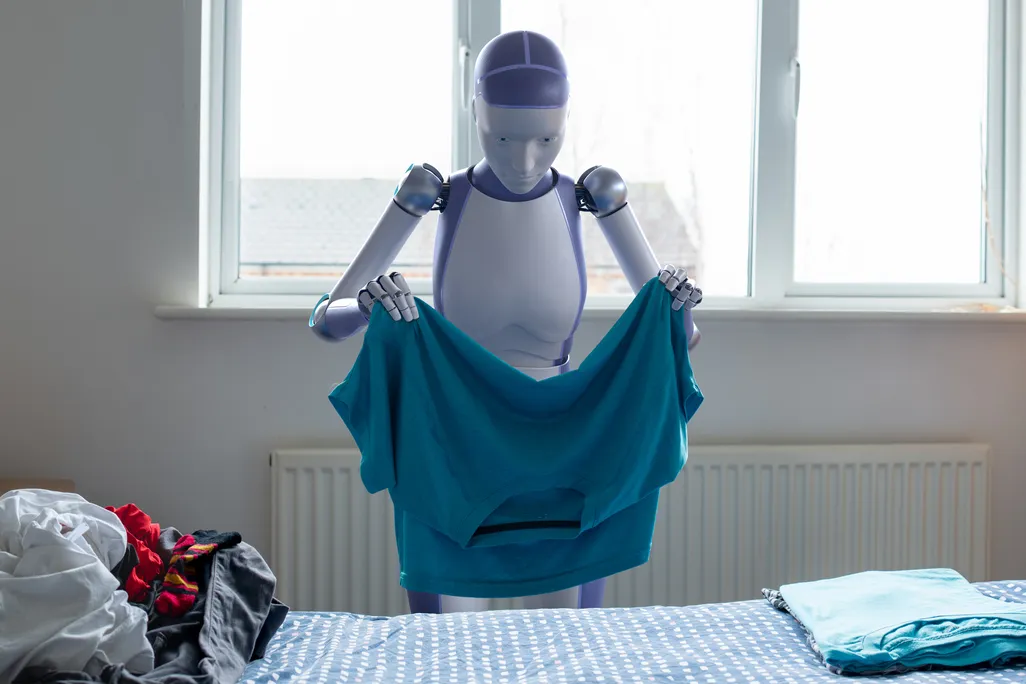
For this chore, the human touch still beats machines. But maybe not for long
More than 60 years ago, Rosie the Robot made her TV debut in “The Jetsons,” seamlessly integrating herself into the Jetson household as she buzzed from room to room completing chores. Now, as reality catches up to science fiction and scientists work to develop modern-day Rosies, one of the most mundane tasks is proving to be a big challenge: folding laundry.
The ordinary-seeming act of picking up a T-shirt and folding it into a neat square requires a surprisingly complex understanding of how objects move in three dimensions. Our own ease in accomplishing such tasks comes from a learned understanding of how different fabrics will respond when folded, even if we haven’t folded them before, but robots struggle to apply what they learn to new situations that may differ from their training. As a result, current robots are slow and often perform poorly on even the simplest of folding tasks.
Now, however, newer approaches that adapt better to real-world scenarios may lay the groundwork for robots folding our laundry in the future.
A big challenge in teaching robots the skill is the infinity of ways that various fabrics can fold. Think about all the times you’ve tossed a T-shirt into the laundry basket and how it landed in a slightly different-shaped heap each time. It’s simple for people to pick up a shirt and quickly find a sleeve or collar to orient themselves, but every unique way a shirt crumples is a new challenge for robots, which are often trained on images of unwrinkled clothing lying flat on a surface, with all features visible.
“It’s not the fabric itself that is the challenge. It’s the number of variations that can be created by the way fabric can be crumpled, and all the different kinds of clothing items that exist,” says David Held, a robotics researcher at Carnegie Mellon University in Pittsburgh.
A newer folding algorithm, AdaFold, adjusts its folding path at each step to reduce crumpling and respond to dynamic changes in the fabric’s shape.
That challenge is easier for people, because we are sensory sponges. Our eyes and hands provide a tremendous amount of information about the world through a lifetime of manipulating three-dimensional objects. Another result of all that learning is that simply looking at a piece of fabric gives us an intuition of how heavy or stretchy it is, and how it would best be folded. It’s clear to us that denim doesn’t fold like silk, for example, but robots don’t automatically understand that more force is required to lift and fold a pair of jeans than a delicate blouse and instead need to interact with the object before determining a folding plan.
Additionally, robots’ “hands” aren’t as versatile as ours. Many have grippers designed specifically for the size and shape of the object that’s going to be manipulated: A robot tasked to screw bolts into a panel of a car, for example, may have a gripper built to grab the exact size of the bolt. Laundry presents a challenge because the dimensions of fabric change with every maneuver, so grippers must be designed to adapt precisely to any shape and size of fabric.
“Humans have flexible hands covered by skin that can sense temperature, texture, whether something is wet or dry,” says Danica Kragic, a computer scientist at KTH Royal Institute of Technology in Sweden and co-author of an article about robotic folding in the 2025 Annual Review of Control, Robotics and Autonomous Systems. The long and short of it, Kragic says, is that “manipulating fabrics requires both advanced hand manipulation capabilities and high-level reasoning.”


