



Close Menu

    Subscribe to Updates

    Get the latest creative news from FooBar about art, design and business.

    What's Hot

    Chulanga Averil Hettiarachchi

    October 13, 2026

    The Higher Education Curriculum Crisis: Why “AI Degrees” are Already Obsolete

    October 13, 2026

    SLASSCOM AI Asia Summit 2026 explores what comes after experimentation

    October 13, 2026
    Facebook X (Twitter) LinkedIn
    Trending
    • Chulanga Averil Hettiarachchi
    • The Higher Education Curriculum Crisis: Why “AI Degrees” are Already Obsolete
    • SLASSCOM AI Asia Summit 2026 explores what comes after experimentation
    • Sri Lanka and Lithuania Hold Bilateral Discussions to Strengthen Digital Economy Cooperation
    • Heat-storing gel could cut buildings’ energy consumption
    • Greenairy is building smart plant towers to clean the air in your office
    • LankaPropertyWeb’s AMPLIFIER wins award for ‘Best AI Solution’ at National AI Awards 2026
    • India – Sri Lanka hold consultations on cyber-security
    Facebook X (Twitter) LinkedIn
    Techie.LKTechie.LK
    Demo
    • Home
    • Local
      1. AI & Machine Learning
      2. Consumer Tech
      3. Cybersecurity
      4. Enterprise Tech
      5. Fintech & Digital Payments
      6. GovTech & e-Governance
      7. Legal & Regulatory Tech
      8. Science & Innovation
      9. Startups & Venture
      10. Telecom & Connectivity
      Featured

      SLASSCOM AI Asia Summit 2026 explores what comes after experimentation

      By Techie.lkOctober 13, 20262
      Recent

      SLASSCOM AI Asia Summit 2026 explores what comes after experimentation

      October 13, 2026

      Sri Lanka and Lithuania Hold Bilateral Discussions to Strengthen Digital Economy Cooperation

      October 13, 2026

      LankaPropertyWeb’s AMPLIFIER wins award for ‘Best AI Solution’ at National AI Awards 2026

      October 9, 2026
    • International
      • AI & Machine Learning
      • Consumer Tech
      • Cybersecurity
      • Enterprise Tech
      • Fintech & Digital Payments
      • GovTech & e-Governance
      • Legal & Regulatory Tech
      • Science & Innovation
      • Startups & Venture
      • Telecom & Connectivity
    • Interviews
    • Profiles
    • Analysis
    • Contributors
    • Podcasts
    • More
      • About Us
      • Contact Us
    Techie.LKTechie.LK
    Home»International»Kaspersky report: Over a million banking accounts compromised as financial threats move to credential theft
    International

    Kaspersky report: Over a million banking accounts compromised as financial threats move to credential theft

    Techie.lkBy Techie.lkApril 8, 2026Updated:April 23, 2026No Comments1 Views
    Facebook Twitter LinkedIn WhatsApp Reddit Tumblr Email
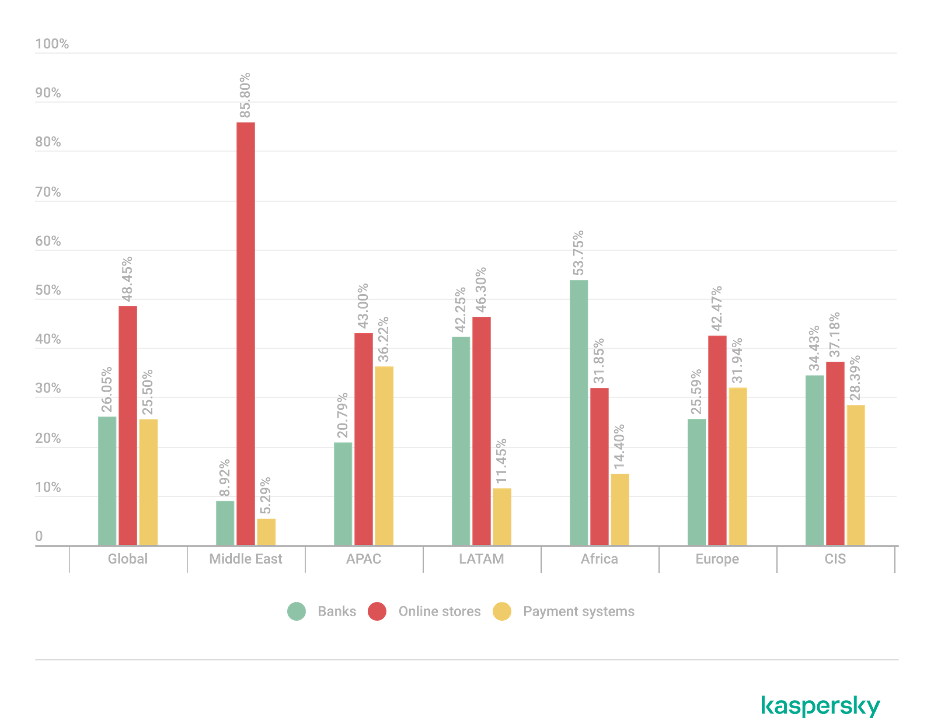
    1. The distribution of detections of financial phishing pages by category globally and per region 2025
    Share
    Facebook Twitter LinkedIn

    More than one million online banking accounts were compromised by infostealers last year, as financial cyberthreats shifted toward credential theft and data reuse. Attackers are moving away from traditional PC banking malware and increasingly relying on social engineering and dark web marketplaces, while mobile financial malware continues to grow. Detailed information on current financial cyberthreat trends is available in Kaspersky’s new report.

    Traditional financial phishing has not gone away. Pages that mimicked e-shops dominated the financial phishing landscape (48.5% in 2025, up 10.3% from 2024), followed by banks (26.1% in 2025, down by 16.5% from 2024) and payment systems (25.5% in 2025, up by 6.2% from 2024). The decline in bank phishing may suggest that these services are becoming increasingly difficult to successfully impersonate, and fraudsters are turning to easier ways to access users’ finances.

    Attackers are adapting campaigns to regional digital habits. In the Middle East, financial phishing is overwhelmingly concentrated on e-commerce (85.8%), indicating a heavy reliance on online retail lures, whereas in Africa bank-related phishing leads (53.75%), which may indicate that user account security there is still insufficient. LATAM shows a more balanced distribution but with a higher share of e-commerce (46.3%) and bank targeting (42.25%), while APAC and Europe display a more even spread across all three categories, pointing to diversified attack strategies.
    1.The distribution of detections of financial phishing pages by category globally and per region 2025
    The distribution of detections of financial phishing pages by category globally and per region 2025

    In 2025, the decline in users affected by financial PC malware continued as users increasingly rely on mobile devices to manage their finances. Contrary to PC banking malware, mobile banker attacks grew by 1.5 times in 2025 compared to the previous year.

    Complementing traditional financial malware, infostealers played a significant role in enabling financial crime both on PCs and mobile devices by harvesting login credentials, cookies, bank card numbers, crypto wallet seed phrases, and autofill data from browsers and applications, which attackers then used for account takeovers or direct banking fraud. Kaspersky data pointed to a surge in infostealer detections (APAC increase by 132% on PCs from 2024 to 2025), fueling credential-based attacks.

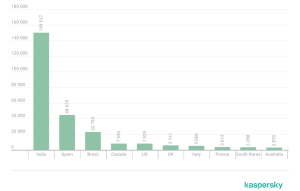
    According to Kaspersky Digital Footprint Intelligence (DFI), in 2025 over one million online banking accounts served by the world’s 100 largest banks fell victim to infostealers: credentials for these accounts were being freely shared on the dark web. The countries with the highest median number of compromised accounts per bank were India, Spain, and Brazil.

    74% of payment cards that were compromised by infostealer malware, published on dark web resources and identified by Kaspersky DFI team in 2025, remained valid as of March 2026. This means that attackers could still use cards that had been stolen months or even years prior.
    The median number of compromised accounts per bank for the TOP-10 countries
    The median number of compromised accounts per bank for the TOP-10 countries

    “The dark web has become a central hub for financial cybercrime. Stolen credentials and bank cards that have been harvested by infostealers are aggregated, repackaged, and sold there, while phishing kits targeted at users of financial products are offered as ready-to-use services. This creates a self-sustaining ecosystem where data theft and fraud operations reinforce each other, making attacks scalable and easy to carry out by fraudsters with minimal experience. Breaking this cycle requires proactive threat intelligence on the part of organizations, and increased awareness and scrutiny from individual users,” comments Polina Tretyak, Kaspersky Digital Footprint Intelligence analyst. Detailed information is available in the full report on Securelist.

    Kaspersky recommends the following to stay protected. For individual users: Use multifactor authentication where possible, create strong unique passwords and safely store them in a password manager. Do not follow links from suspicious messages and double-check web pages before entering your credentials or banking card details. To protect yourself from fake e-shops and phishing pages use a reliable security solution. Kaspersky Premium protects users from fraudulent online stores and phishing websites through advanced detection technology that analyzes website characteristics and URLs to identify suspicious patterns.

    For businesses: Assess the entire infrastructure, fix vulnerabilities, and consider external specialists for fresh perspectives that reveal concealed risks. Deploy integrated platforms to monitor and control all attack vectors with rapid detection and swift response across the organization. Solutions from the Kaspersky Next product line can help with this, as they provide real-time protection, threat visibility, investigation, and EDR/XDR capabilities scalable to organizations of any size and in any industry. Continuous monitoring of dark web resources significantly improves the coverage of various sources of potential threats, and allows customers to track threat actor’s plans and trends in their activities. This type of monitoring is a part of Kaspersky’s Digital Footprint Intelligence service.

    Share. Facebook Twitter LinkedIn
    Techie.lk
    • Website

    Related Posts

    Heat-storing gel could cut buildings’ energy consumption

    October 13, 2026

    Greenairy is building smart plant towers to clean the air in your office

    October 13, 2026

    Agentic coding is now multiplayer: Introducing Slack Code

    October 9, 2026
    Leave A Reply Cancel Reply

    Demo
    Top Posts

    Chadika Yahampath: Head of Digital Capacity Building, GovTech Sri Lanka

    September 21, 2026283

    The Exit Plan: The Leadership Lessons No Startup Can Afford to Ignore

    August 18, 2026214

    The Death of the Traditional Software Engineer: Bridging the Talent Gap in the Post-AI Era

    August 10, 2026112

    Solve a Global Problem from Sri Lanka: Haridhu Abeygoonaratne on Building a Product Nation

    October 6, 202693
    Don't Miss
    Contributors

    Chulanga Averil Hettiarachchi

    By Techie.lkOctober 13, 20261

    Chulanga Averil Hettiarachchi is a Project Manager and technology professional specializing in AI solutions, business…

    The Higher Education Curriculum Crisis: Why “AI Degrees” are Already Obsolete

    October 13, 2026

    SLASSCOM AI Asia Summit 2026 explores what comes after experimentation

    October 13, 2026

    Sri Lanka and Lithuania Hold Bilateral Discussions to Strengthen Digital Economy Cooperation

    October 13, 2026
    Stay In Touch
    • Facebook
    • Twitter
    • LinkedIn

    Subscribe to Updates

    Get the latest creative news from SmartMag about art & design.

    Demo
    About Us
    About Us

    Your source for the lifestyle news. This demo is crafted specifically to exhibit the use of the theme as a lifestyle site. Visit our main page for more demos.

    We're accepting new partnerships right now.

    Email Us: techielkeditor@gmail.com
    Contact: +94 77 328 0773

    Facebook X (Twitter) LinkedIn
    Our Picks

    Chulanga Averil Hettiarachchi

    October 13, 2026

    The Higher Education Curriculum Crisis: Why “AI Degrees” are Already Obsolete

    October 13, 2026

    SLASSCOM AI Asia Summit 2026 explores what comes after experimentation

    October 13, 2026
    Most Popular

    Chadika Yahampath: Head of Digital Capacity Building, GovTech Sri Lanka

    September 21, 2026283

    The Exit Plan: The Leadership Lessons No Startup Can Afford to Ignore

    August 18, 2026214

    The Death of the Traditional Software Engineer: Bridging the Talent Gap in the Post-AI Era

    August 10, 2026112
    © 2026 Techie. Designed by NIKO.
    • Terms & Conditions
    • Privacy Policy

    Type above and press Enter to search. Press Esc to cancel.