










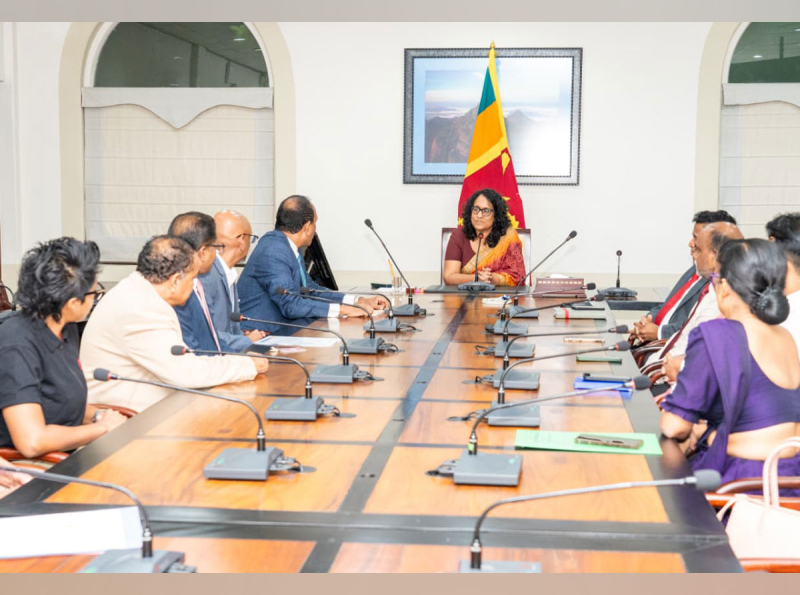
Prime Minister Dr. Harini Amarasuriya has called for a broader approach to digitalising Sri Lanka’s education system, stating that hardware alone will not deliver results without quality content and properly trained teachers.
The Prime Minister made these remarks during a discussion held at the Prime Minister’s Office on 8 May with representatives of Rotary International and professionals from Sri Lanka’s software industry, facilitated by the Digital Task Force.
She pointed out that smart classrooms should not be limited to merely displaying YouTube videos, but must instead focus on creating high-quality digital educational content aligned with the national curriculum. The comment signals a concern that the country risks investing in expensive infrastructure that delivers little pedagogical value in practice.
The Prime Minister also stressed the importance of delivering all educational materials through an official government platform such as e-Thaksalawa, rather than through various private platforms, to ensure consistency and quality standards.
On teacher readiness, Dr. Amarasuriya highlighted the need to implement digital training programmes centred around the 20 National Colleges of Education responsible for teacher training, noting that familiarising approximately 6,000 trainee teachers annually with digital technology could bring about a qualitative transformation within the school system.
The meeting also shed light on the current rollout plan. Steps are being taken to establish smart classrooms in 100 selected schools. Under the first phase, facilities will be provided to 50 schools, with the remaining 50 to follow in a later phase.
Representatives of Rotary International stated that they are prepared to provide digital learning platforms to the government free of charge and support the creation of educational content using modern technologies including Artificial Intelligence. The offer points to growing private sector and civil society interest in contributing to the country’s digital education push, though both parties acknowledged that the sustainability of such partnerships requires firmer structural footing.
Attention was drawn to the importance of establishing a formal agreement-based mechanism between the government and the private sector to ensure the long-term sustainability of these projects, with discussions also covering practical challenges such as electricity costs and internet connectivity expenses in schools.
The Prime Minister stated that a five-year plan for the digital transformation of the education system will be finalised in the near future and requested Rotary representatives to contribute in line with the priorities identified within the plan.
The discussion was attended by senior officials from the Prime Minister’s Office and the Ministries of Education, Higher Education and Vocational Education, representatives of the Digital Task Force, and officials from Creative Software and Cambio Software Engineering.
This conversation sits within a broader reform agenda that the government has been advancing over the past year. A Digital Task Force had earlier been tasked with submitting a comprehensive digital education policy framework to Cabinet, with the digitalization process expected to focus on six sectors and provide a meaningful response to the teacher shortage.
The Prime Minister’s remarks suggest the government is aware of the gap between rolling out infrastructure and achieving actual learning outcomes, a gap that has tripped up similar initiatives in other markets. Whether the five-year plan in preparation will set measurable benchmarks for content quality and teacher competency will be the test of whether this round of reform goes beyond the symbolic.


