



A year ago, a relatively unknown Chinese AI startup sent shockwaves through Silicon Valley by releasing a model that matched the performance of America’s best at a fraction of the cost. Now DeepSeek is back, and this time it is not just catching up. It is claiming the top spot.
On April 24, 2026, DeepSeek unveiled preview versions of its new flagship model, the V4 Flash and V4 Pro series, on Hugging Face. The company is calling it the most powerful open-source AI platform available today, positioning it as a direct challenge to OpenAI, Anthropic, and Google DeepMind.
The new models come with a suite of notable technical upgrades. DeepSeek has introduced what it calls a Hybrid Attention Architecture, a design that significantly improves the model’s ability to retain context across long conversations. This has long been a weak point for large language models handling complex, multi-turn tasks. The company has also extended the context window to one million tokens, meaning an entire codebase, a lengthy legal document, or a long research paper can be submitted as a single prompt without losing coherence.
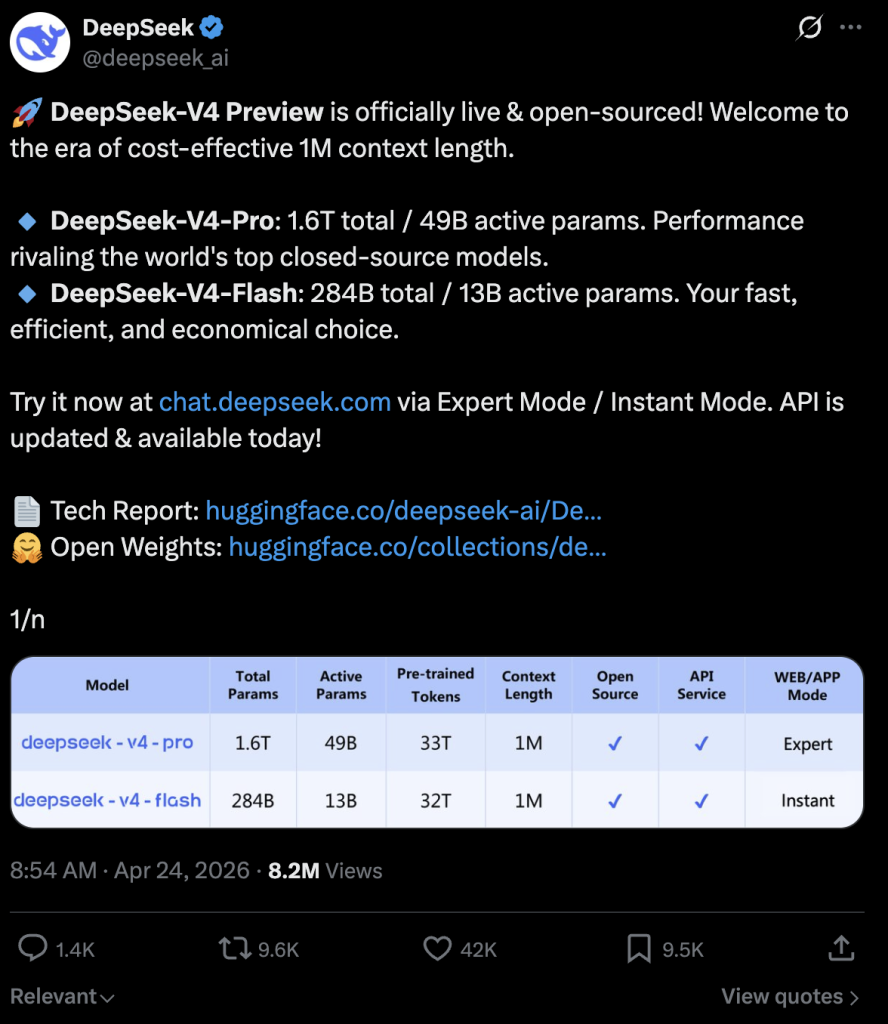
Benchmark performance is strong across coding, reasoning, and agentic tasks, which refers to the ability of AI systems to autonomously plan and execute multi-step actions without human intervention. DeepSeek says these improvements make V4 Pro the leading open-source model on several key evaluations, though independent third-party verification is still ongoing as of publication.
What makes this announcement particularly significant is the open-source angle. While OpenAI and Anthropic keep their most capable models behind commercial APIs, DeepSeek continues to release model weights publicly. This means developers anywhere in the world, including Sri Lanka, can download, run, and fine-tune these models on their own infrastructure without paying per-token fees. For startups and research teams operating on tight budgets, that is not a small thing.
The timing of the release is also meaningful geopolitically. Chinese AI labs are operating under significant US export restrictions that limit their access to advanced semiconductors, particularly Nvidia’s highest-end chips. Despite that, DeepSeek has repeatedly demonstrated that efficiency and architectural innovation can compensate for raw compute constraints. As Nvidia CEO Jensen Huang publicly noted last year, China’s AI researchers are producing world-class work. The V4 release only reinforces that point.
For businesses and developers in Asia evaluating which models to build on, DeepSeek V4 has just made the decision considerably more complicated and considerably more interesting.