



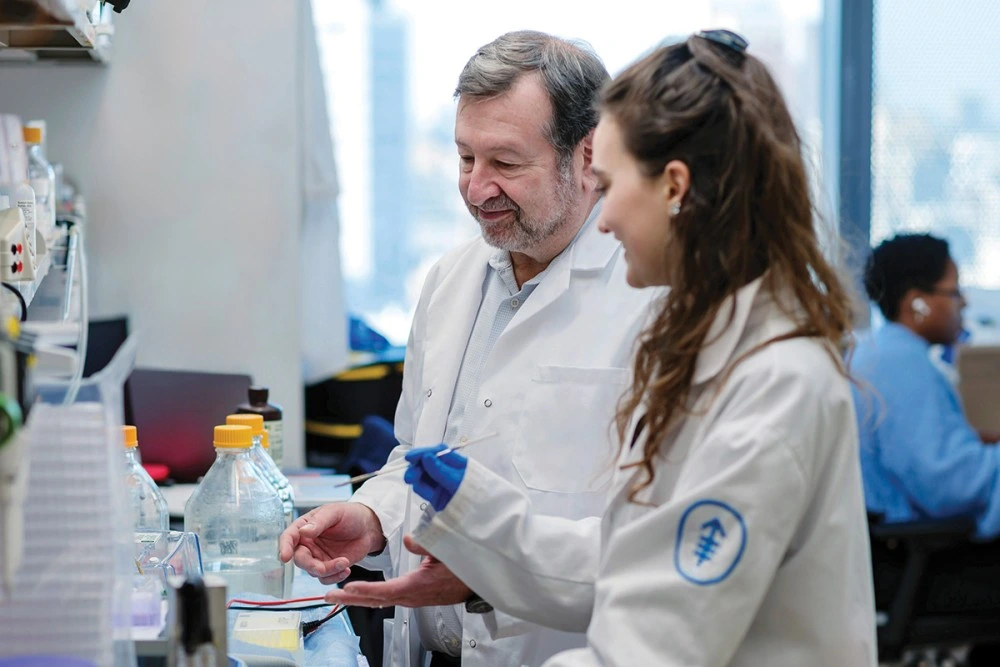
A new cancer vaccine significantly improved survival in patients with acute myeloid leukemia. Dr. David A. Scheinberg, a leader of immunotherapy drug development at MSK, worked with colleagues to develop this ready-made, “off-the-shelf” vaccine for more than two decades.
A cancer vaccine appears to significantly improve survival in people in remission from one of the most common and aggressive blood cancers, acute myeloid leukemia (AML), according to new results from a phase 3 clinical trial.
The vaccine, galinpepimut-S (or GPS), was invented by David A. Scheinberg, MD, PhD, a leader in immunotherapy drug development at Memorial Sloan Kettering Cancer Center (MSK).
The clinical trial, which included 126 patients, was led by SELLAS Life Sciences Group. The study found:
- The vaccine reduced the risk of death by 41%.
- The median overall survival was 24.0 months in those receiving the vaccine, compared with 14.7 months for patients on standard treatments — a difference of 9 months.
- The vaccine appeared safe, with minimal side effects – most commonly reactions at the injection site.
As a therapeutic cancer vaccine, it works by teaching the immune system to fight remaining traces of cancer cells that may be undetectable following treatment but ultimately can lead to a relapse.
The GPS is a complex “peptide” vaccine that triggers a targeted immune response by using synthetic peptides, which are the building blocks of proteins. The vaccine targets a protein called WT1, found in the cancer cells of more than 95% of people with AML (as well as in ovarian cancer, mesothelioma, and other cancers and leukemias).
The GPS vaccine is ready-made and “off-the-shelf” — as opposed to a personalized vaccine individually designed for each patient. Because off-the-shelf vaccines don’t need to be custom-manufactured, the hope is that they can be mass-produced, stored, and administered right away.
“Two decades of research have given us a much clearer picture of how the immune system can recognize and attack tumors and leukemias,” Dr. Scheinberg says. “These insights are helping lay the groundwork for these exciting, new immune-based approaches that could safely benefit more people with cancer. These data bring us closer to having the first off-the-shelf vaccine for AML patients.”
The GPS vaccine: a pressing need for better treatments
Although rare overall, acute myeloid leukemia is one of the most common types of blood cancer. It moves quickly and needs aggressive, often harsh, treatment with chemotherapy, sometimes followed by a bone marrow transplant. Even when these therapies stop the cancer, AML often returns, and treatment options have been limited. Modern immunotherapies that have worked well for other cancers have not had success against AML.
Dr. Scheinberg says cancer vaccines are well-suited to mop up lingering malignant cells after successful treatment. But until recently, results have been disappointing. A major problem was that the vaccines were too narrowly focused or didn’t activate enough parts of the immune system.
“Tumors have different antigens from cell to cell,” he says. “Some tumor cells are attacked, but others survive and grow. In addition, cancers have several ways of eluding an immune attack, so you need a multipronged response.”
An innovative design expands the vaccine’s scope
To create a more comprehensive attack, Dr. Scheinberg designed GPS to use four different peptides derived from the WT1 protein.
The peptides were slightly altered from their natural form to look more foreign to the immune system. Dr. Scheinberg’s team also added ingredients called “adjuvants” to further boost the immune response.
When a patient receives an injection, the vaccine is taken in by immune cells called dendritic cells and macrophages. In turn, they stimulate two kinds of T cells, which are the body’s killer immune cells. Once the T cells switch on, they go hunting for cells with high levels of WT1 — a telltale sign of AML.
It’s a one-two punch that lasts.
“One of the innovations of this treatment is that it activates two different types of T cells: CD8 T cells and CD4 T cells,” Dr. Scheinberg says. “The CD8 T cells directly attack the cancer cells, while the CD4 T cells help boost the attack and support long-term protection against the cancer. Previous treatments that had been tested did not activate the CD4 T cells, which we realized was critical.”
SELLAS is preparing to submit the vaccine for approval by the U.S. Food and Drug Administration (FDA) in the first half of 2027.
Gratifying success after decades of research
The trial’s results point to the potential of GPS as a completely new form of “maintenance immunotherapy,” which prevents the disease from returning after primary treatment. It also validates the concept that cancer vaccines can be effective if designed and engineered to foil cancer’s tricks to outsmart the immune system.
Dr. Scheinberg and his colleagues at MSK have been developing GPS for more than two decades. His team persisted in the approach amid skepticism from other scientists and many pharmaceutical companies.
“I’ve been working in immunology drug development for 40 years, and given the nature of the field, I’ve had plenty of failures and some successes,” he says. “I’m happy this was a success, but I’ll be even happier when I see the first patient be able to get it when they come into the clinic.”
Dr. Scheinberg says advances in technology, including mRNA-based platforms, promise to speed the development of newer cancer vaccines that use the multipronged approach proved successful by GPS.
“It’s great for the field, for the young scientists to see that things can actually work,” he says. “I tell the students in my lab, ‘If I could do this, you’ll do it even better because you’ll have better technology.’ ”
Dr. Scheinberg holds the Vincent Astor Chair.
Disclosure: Memorial Sloan Kettering (MSK) and Dr. Scheinberg have financial interests related to SELLAS Life Sciences.