



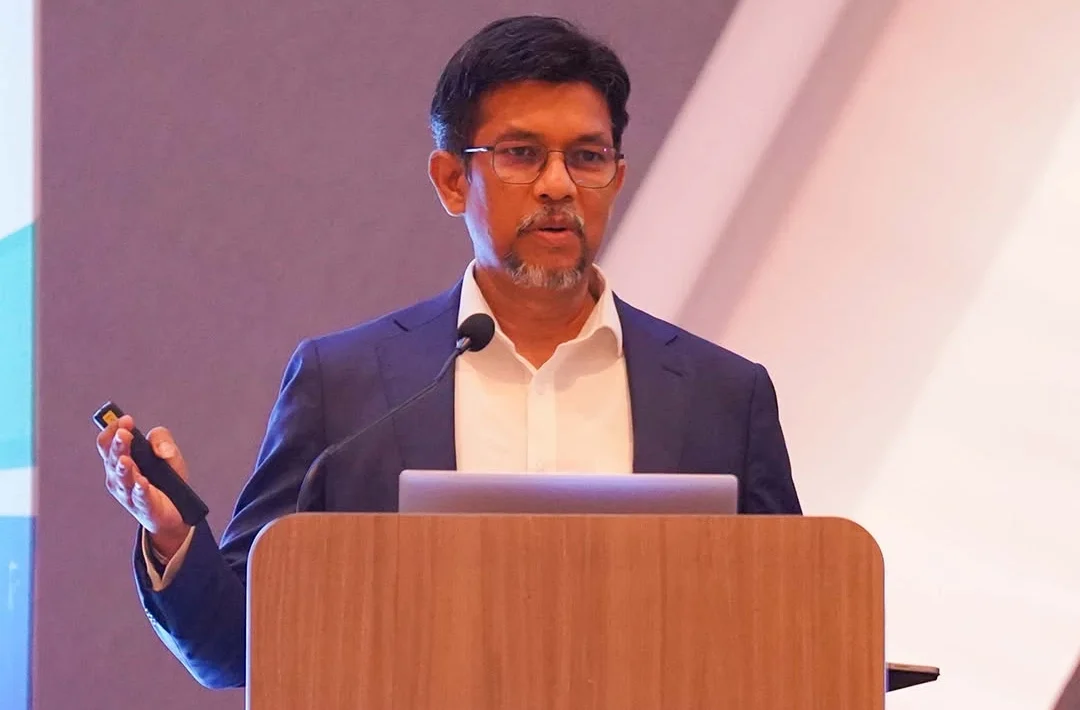
Speaking as the Chief Guest and keynote speaker at the Technical Committee Session of the 63rd Asia-Pacific Broadcasting Union (ABU) General Assembly, held at Cinnamon Life in Colombo, Deputy Minister of Digital Economy, Eng. Eranga Weeraratne, stated that media, technology, and regional cooperation must move in tandem to build a developed and secure digital future. Anchored on the overarching summit theme, ‘Media for Peace and Humanity: Truth, Trust, and Transformation’, the Deputy Minister highlighted both the technological opportunities and operational challenges confronting the modern media landscape.
Digital infrastructure is a fundamental right
Elaborating on the Government’s strategic vision for digital economic transformation, the Deputy Minister outlined the DIGIECON 2030 national framework, which aims to drive high-value job creation, boost exports, and deliver transparent, citizen-centric public services. He emphasized that core Digital Public Infrastructure (DPI), such as the Sri Lanka Unique Digital Identity (SLUDI) and the GovPay platform, is actively being established, reiterating that the Government views digital infrastructure as a fundamental right equal to physical roads and electricity grids.
Addressing the ongoing digital shift within the broadcasting sector, the Deputy Minister noted that emerging technologies such as cloud computing, IP workflows, and Artificial Intelligence (AI) present unprecedented opportunities for media innovation. In a multilingual nation like Sri Lanka, AI can streamline content translation, real-time subtitling, and archive preservation.
However, he cautioned against the risks of misinformation and deepfakes that erode public trust. To mitigate these threats, the Government is establishing the National AI Institute and implementing safeguards through the Personal Data Protection Act.
Expanding reliable connectivity across both urban and rural areas
Stressing the imperative of digital inclusion, Deputy Minister Eng. Eranga Weeraratne reaffirmed the Government’s commitment to expanding reliable connectivity across both urban and rural areas, ensuring that the benefits of the digital economy reach women, youth, senior citizens, and persons with disabilities.
He concluded by asserting that digital transformation cannot be achieved by any nation in isolation, urging Asia-Pacific economies, technology firms, and media institutions to foster strong regional partnerships and share expertise to build a fully connected ecosystem.
The session was attended by Dr. Kaushalya Ariyarathne, Deputy Minister of Mass Media; Mr. Masashi Kamei, President of NHK Japan; Mr. Zhang Wei, Vice President of RTPRC; Dr. Mohieddin Moradi, Vice President of IRIB Iran; Mr. Nguyen Duc Tue, Vice President of VTV Vietnam; and Mr. Tharanga Nadeeka Silva, Vice President of MTV Sri Lanka, alongside members of the Technical Committee, panellists, international delegates, and distinguished guests.
(Ministry of Digital Economy)