



By Shannine Daniel for Techie.lk
In September, Techie.Lk participated in the Demo Day of the AI Launch Pad incubator programme by Ascentic, which saw 50 IT undergraduates and recent graduates being encouraged and mentored to take up an idea for a new and exciting programme or application and develop it from scratch.
From planning and designing to implementation and presenting the idea, Ascentic’s team of mentors, or ‘Ascenders,’ were with these young undergraduates offering them advice, support and guidance as part of an ingenious corporate social responsibility (CSR) effort that bridges the gap between university-level academia and industry-level skills and innovation.
For many university students, graduation comes with a certificate proving what they have studied. Ascentic’s AI Launch Pad was built around a different proposition: Graduates should also be able to demonstrate what they can actually build.
The eight-week long community initiative was created against a backdrop of growing competition for opportunities among students and fresh graduates. Ascentic had been running internship programmes for years, but the scale of demand was becoming increasingly difficult to ignore.
According to Dilini Rajapakse, Ascentic’s Head of Innovation & Business Development, internship advertisements could attract around 1,000 CVs, highlighting the gap between the number of graduates seeking opportunities and the places available to them.
“We may not be able to solve the whole problem, but we can always set an example,” Dilini said, explaining the thinking behind the Launch Pad, in an exclusive interview with Techie.Lk.
The initiative was therefore designed not as another conventional training programme, but as an opportunity for university students to take an idea through the process of building a real product.
The Launch Pad brought together industry professionals and community collaborators for six structured sessions spread across the eight weeks. The sessions took place online, generally over two hours each weekend, with each week focusing on a key concept that participants could immediately apply to their own projects.
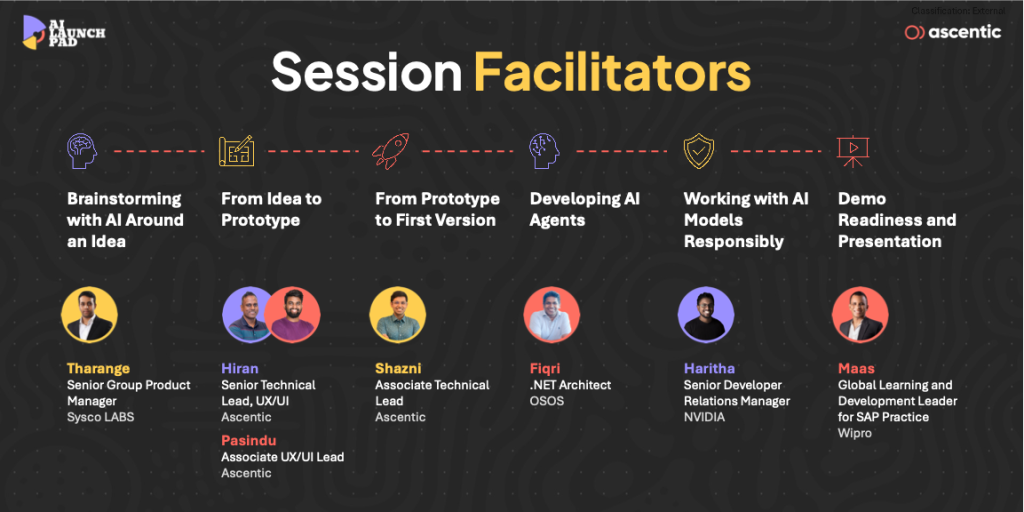
The Ascentic AI Launch Pad brought together industry professionals and community collaborators for six structured sessions spread across eight weeks.
Acccording to Dilini, the programme attracted around 700 applications, from which 50 participants were selected, and instead of using university quotas or relying primarily on academic performance, Ascentic introduced an AI chatbot into the application process.
Applicants were able to explain their previous experiences and experiments with AI, allowing the organisers to explore their interests in greater depth before making the final selection.
“We wanted to see that attitude of application, not just academics,” Dilini said, elaborating that the focus was on identifying students who had already demonstrated curiosity and initiative; people who had tried something, perhaps failed, but continued to experiment.
According to Dilini, the Launch Pad was not restricted to the 50 selected participants. The sessions remained open to registered participants, allowing a wider group of students to access the programme’s learning content.
Building mentorship around a challenge was a major component of the programme, with 43 mentors volunteering their time from Ascentic. While the initial structure provided one hour of mentoring each week after the main session, mentors and mentees were free to arrange additional sessions as their projects progressed.
Interestingly, mentor-mentee pairs were randomly matched rather than being assigned according to technical specialisations.
“We wanted to challenge both parties. It wasn’t only the mentees that we were grooming and skilling up. The mentors were also parallelly getting skilled up,” Dilini explained.
The company’s approach was intended to push participants outside familiar areas and encourage mentors to apply their experience in different contexts.
Mentorship also extended beyond simply answering technical questions, and participants were encouraged to reconsider their ideas when necessary. If an initial concept proved unviable, mentors helped them assess the problem, make changes and pivot.
The objective was ultimately to help participants arrive at projects they genuinely cared about. In simple words, it was about them creating something they would have the motivation to continue building.
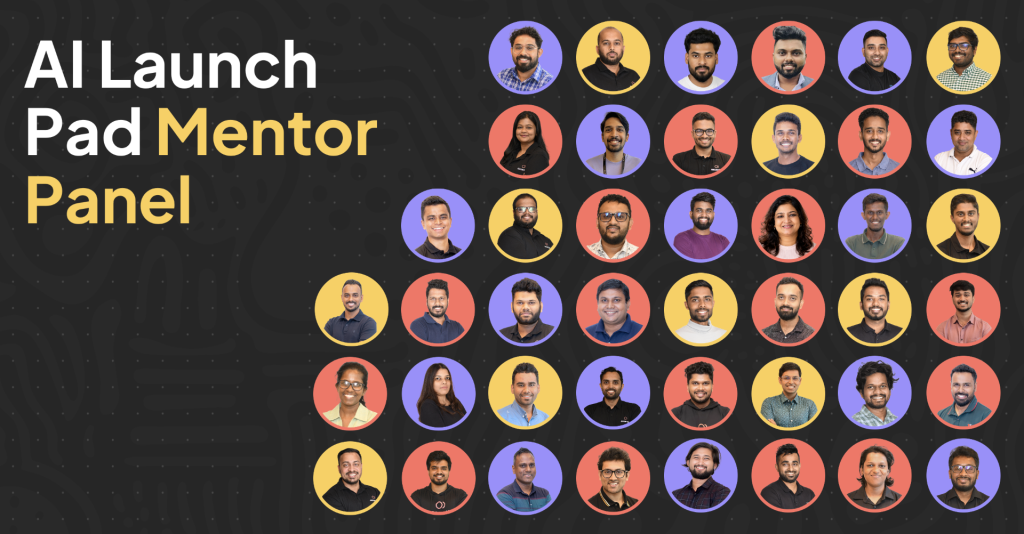
Building mentorship around a challenge was a major component of the programme, with 43 mentors volunteering their time from Ascentic.
The Launch Pad’s central philosophy was captured in its guiding idea: “Graduate with proof of what you can build.”
For Dilini, that distinction matters because traditional education can demonstrate that someone understands a concept without necessarily demonstrating that they can apply it.
“You can have an idea, and you can take it into a final product, if you actually follow this process, use the tools wisely and understand the concepts deeply,” she elaborated.
Participants were encouraged to follow an AI-driven product-development process covering ideation, prototyping, building, responsible use of models and presenting the final product.
Their work had to be documented through reports and code submissions, while participants also submitted recorded presentations and answered questions about how they had applied AI.
The projects themselves were expected to address problems that mattered to the participants.
“We wanted them to reflect on ideas that really matter to them,” Dilini said, adding that the organisers also wanted to see how deeply participants had explored their chosen domains.
That resulted in projects rooted in personal interests and real-world problems, including an application designed by a promising young girl to support a grandmother with dementia and another focused on veterinary care.
The process also gave participants permission to fail. As ideas developed, some were changed or abandoned when participants discovered that they were not viable.
The objective was not to force every student to defend their original idea, but to teach them how to respond to problems during the process of building.
The programme did not end with simply submitting a project.
As mentioned by Dilini, participants were required to provide technical evidence of their work, after which a senior technical judging group reviewed the submissions and shortlisted 20 participants. The top 20 then had to defend their ideas before a panel, with the final 10 selected based on their ability to explain the project, articulate its value and demonstrate a viable business case.
The finalists also received additional preparation before Demo Day, spending several hours with the Ascentic team refining their presentations and learning how to explain why their ideas mattered, how they had implemented them and what challenges they had encountered.
That preparation highlighted another gap the programme sought to address: building the communication and presentation skills needed to take a technical project beyond the development stage.
For participants who wanted to commercialise their ideas, Dilini acknowledged that further support would be required, particularly around investment and financial aspects.
Ascentic has already begun exploring connections to angel investors and incubator programmes, with the intention of helping participants take their projects further.
The Launch Pad was free for participants, and Ascentic deliberately avoided creating a programme dependent on paid AI resources.
Rather than providing participants with AI credits, the organisers encouraged them to use free tiers and open-source tools wherever possible. The constraint itself became part of the learning process.
“We wanted to encourage that exploratory mindset,” Dilini said.
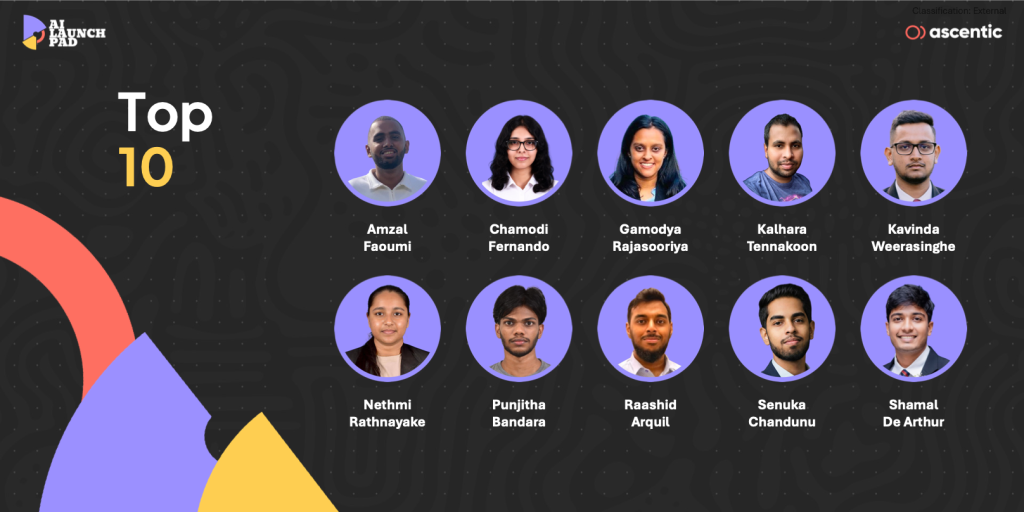
The final 10 participants of the Ascentic AI Launch Pad were selected based on their ability to explain the project, articulate its value and demonstrate a viable business case.
Participants had to find their own ways around subscription limits and other resource constraints, sometimes switching between tools and services to keep their projects moving. According to Dilini, this became an unexpected demonstration of their resourcefulness.
For Ascentic, the primary motivation of the Launch Pad was giving back, with around 55–60 people from the company volunteering more than 1,000 hours of their time and effort, stated Dilini.
“There was substantial commitment from the mentors and it was a complete CSR effort,” she said, adding that she saw an additional value for Ascentic itself, by giving experienced professionals a direct view of what university students are capable of building with today’s AI tools.
Ultimately, the biggest challenge for the Launch Pad may be its own success, through heavy voluntary contributions from the mentors and organisers, making it difficult for one company to repeatedly sustain the same level of commitment.
For Dilini, the solution is not necessarily for Ascentic to run the same programme indefinitely. Instead, she sees greater potential in other companies and members of the technology community adopting the model.
“If we can see many other companies actually picking up on this idea, and doing something similar, and potentially even the community coming together to do something similar, I would say the biggest win for us,” she said.
That would transform the Launch Pad from a single corporate initiative into a broader community model for developing practical technology skills.
What made the AI Launch Pad significant was the fact that it challenged the participants to show what they can create.
Rather than measuring success solely through attendance or completion, the programme required students to demonstrate that they could move from an idea to an actual product, explain the decisions behind it, respond to failure and communicate its value.
That is the thinking behind “graduate with proof of what you can build.”
The programme also demonstrated what can happen when industry professionals contribute their time to bridge the gap between academic learning and practical application. As Dilini noted, mentors were balancing full-time jobs and family commitments while still choosing to dedicate two months to working with students.
The next stage may therefore depend less on whether Ascentic repeats the Launch Pad and more on whether others take the idea forward.
For a technology sector being reshaped by AI, the broader lesson is straightforward: Learning how AI works is only part of the journey. The ability to experiment, build, fail, adapt and ultimately show what you have created may be the proof that matters most.
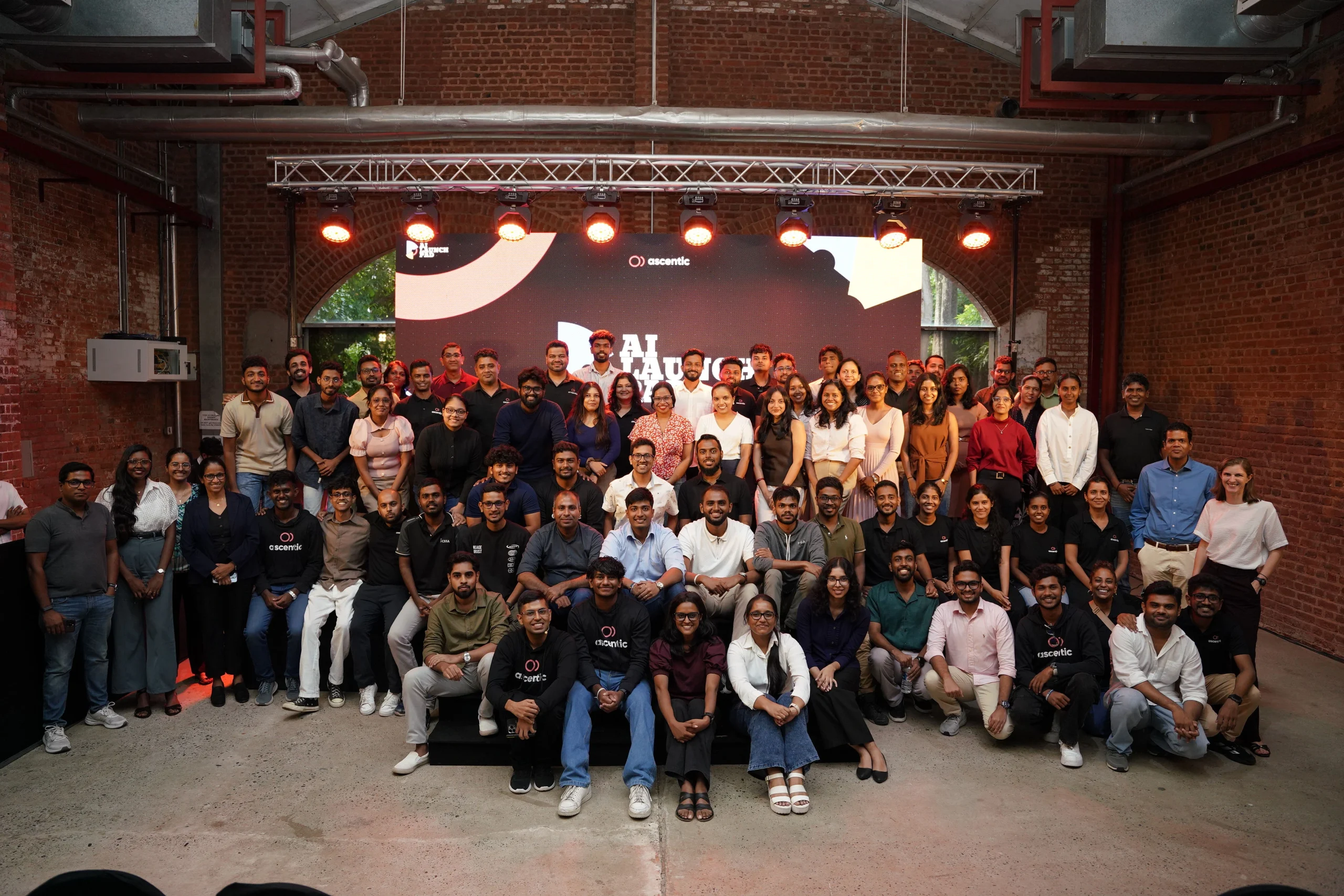
Featured image: The participants at Demo Day of Ascentic’s AI Launch Pad, which was held on September 19th at Trace Expert City in Colombo.