



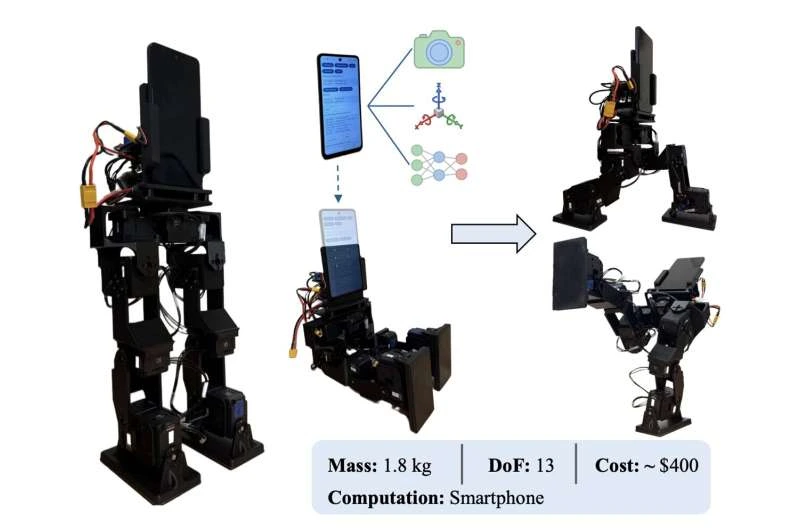
PhoneBot uses a torso-mounted smartphone for camera vision, motion sensing and movement-control computation. The researchers estimate its hardware cost at about $400, excluding the handset.
Smartphones combine cameras, motion sensors and powerful processors in devices that fit inside a pocket. These features could also make them useful components for robots, reducing the need to buy and connect separate sensors, processors or other electronics.
Researchers at the University of California, Los Angeles, recently developed PhoneBot, a small humanoid robot that relies on an Android smartphone to sense its surroundings and control its movements. Their proposed system, introduced in a preprint posted to arXiv, could make robotics experiments more accessible for students and researchers worldwide.
The phone does the heavy thinking
PhoneBot stands approximately 19 inches (48 centimeters) tall and weighs about 4 pounds (1.8 kilograms), including the smartphone it relies on. The researchers estimate its hardware cost at around $400, excluding the smartphone. In initial demonstrations, the team showed that the robot can walk, track a person and stand up from a face-down position.
The smartphone is mounted above PhoneBot’s hips, essentially forming its torso. The phone’s camera allows the robot to detect and track people, while its motion sensors can gather information about the body’s movement and orientation.
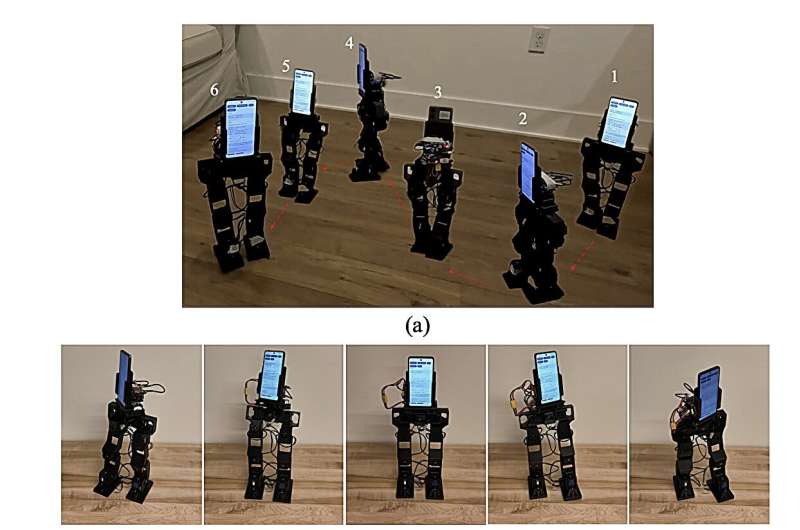
Physical demonstrations show PhoneBot walking (a), tracking a person with its camera (b) and rising from a face-down position (c).
The phone also runs the software controlling the robot’s movements. It sends commands over Wi-Fi to a small onboard computer, which forwards them to the motors.
PhoneBot has 13 motors: six in each leg and one that rotates its torso. This additional joint allows the camera to turn sideways while the robot’s feet remain planted.
The team tested their proposed system using four Android phones, including a 2017 Honor 9, a Moto G 2025, a Samsung Galaxy A16 5G and a Moto G 2024. All four phones supported the core sensing, movement-control and vision functions, suggesting that these tasks do not require a recent flagship phone.
However, the team found that the Honor 9 could not run the application’s onboard mapping feature because the required Google services were unavailable on the device.
Building on an earlier platform
Earlier work by researchers at Intel’s Intelligence Systems Lab introduced OpenBot, a platform combining a smartphone with a wheeled body that costs approximately $50. PhoneBot extends this approach to a robot that needs to maintain its balance while walking.
The team at UCLA trained the robot’s movement-control software in simulation, accounting for the limited strength of its motors. This helped prevent it from learning movements that the physical hardware could not perform.
Yet training the software without an additional adjustment sometimes produced an uneven walking pattern. The left foot remained forward, while the right leg carried much of the load, despite the robot’s symmetric construction.
To address this, the team added a mirrored version of each training example, swapping left and right. The software could learn from both versions without requiring another simulation step.
Comparing five independent training runs with mirrored examples and five without them, the researchers found that mirroring improved learning speed and consistency in simulation. It also helped distribute motor loads between the two legs more evenly. The resulting controls were deployed on the physical robot, which successfully walked, tracked an individual and stood up.
A platform to build on
PhoneBot currently has no arms, and its movement controls were trained on flat terrain. Its inexpensive motors also limit how much weight it can carry and how vigorously it can move.
In the future, the researchers plan to investigate walking on uneven terrain and the addition of lightweight arms for handling objects.
The platform also supports spoken interaction using the phone’s microphone and speaker. However, speech recognition and language processing currently run on an external laptop. The researchers plan to explore running suitable language models on the smartphone to reduce this reliance.
The researchers describe PhoneBot as an open-source platform intended to be reproduced and adapted by others. This could provide a starting point for robotics experiments in classroom and laboratory settings.
(Tech Explore)